Nigeria’s ability to attract and retain both domestic and international investment will depend greatly on trust, transparency and the quality of institutions underpinning the country’s capital market, Coronation Asset Management has said.
The warning was delivered at the 2026 Coronation Media Parley, organised in collaboration with the Capital Market Correspondents Association of Nigeria (CAMCAN), which brought together capital-market journalists, industry leaders and researchers to examine investment opportunities and risks in the second half of the year.
Nigeria’s ability to attract and retain both domestic and international investment will depend increasingly on trust, transparency and the quality of institutions underpinning the country’s capital market, Coronation Asset Management has said.
The warning was delivered at the 2026 Coronation Media Parley, organised in collaboration with the Capital Market Correspondents Association of Nigeria (CAMCAN), which brought together capital-market journalists, industry leaders and researchers to examine investment opportunities and risks in the second half of the year.
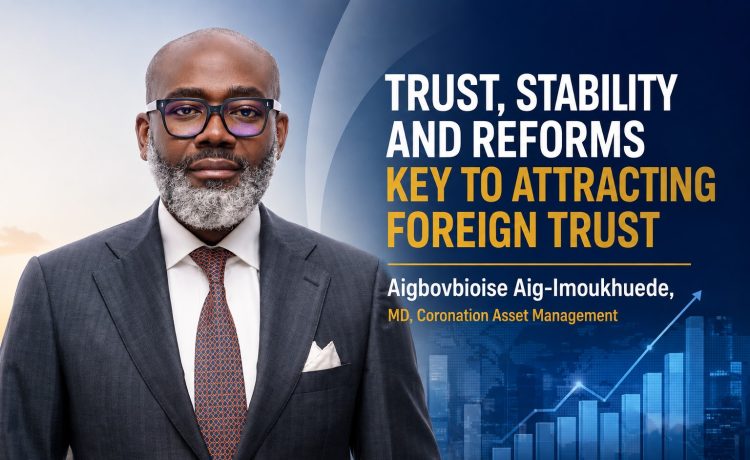
Speaking on the theme “Positioning for the Second Half: Market Outlook, Capital Flows and Investment Opportunities,” Aigbovbioise Aig-Imoukhuede, Managing Director of Coronation Asset Management, said the next stage of Nigeria’s capital-market development must focus on more than attracting money into the market.
According to him, the credibility of the institutions receiving and deploying capital will be critical to sustaining investor confidence.
“Nigeria’s capital markets do not simply need capital. They need trust. They need transparency. And they need institutions willing to be judged by the quality of their thinking, not merely the size of their returns,” Aig-Imoukhuede said.
His comments come against the backdrop of a significant change in the composition of investors participating in the Nigerian market.
Foreign investors accounted for 12.1 per cent of NGX transaction value as of June 2026, down from 27.1 per cent a year earlier.
Domestic investors, particularly pension funds and other institutional investors, have meanwhile become more prominent in market activity.
Aig-Imoukhuede said the development should not be viewed simply as a decline in foreign interest, but as evidence that Nigeria is developing a stronger domestic capital base.
He argued that a market supported by domestic savings is better positioned to withstand volatility and attract longer-term investment.
“Markets become resilient when they are supported by savings rather than speculation,” he said.
Despite the decline in foreign investors’ share of transaction value, speakers at the parley identified several developments that could support renewed international participation.
Improving foreign-exchange liquidity, a stronger reserve position and greater currency stability are creating a more supportive environment for foreign investors.
The continued banking recapitalisation cycle, corporate earnings and broader economic reforms could also strengthen the investment case for Nigeria.
A potential review of Nigeria’s classification by global index providers was identified as another possible catalyst. While there is no guarantee of a favourable outcome, any change in classification could increase Nigeria’s international visibility and potentially support new passive and active investment flows.
Aig-Imoukhuede said investors should not necessarily wait for every uncertainty to disappear before positioning themselves.
“The best opportunities are often identified before consensus recognises them. Those who wait for certainty will almost certainly pay a higher price than those willing to position for probability,” he said.
However, attracting foreign capital is only one part of the challenge. The greater test, according to Aig-Imoukhuede, is whether Nigeria can create the level of trust required to keep capital invested for the long term.
“Capital is mobile. Trust is not. Capital can enter a market quickly and leave just as quickly. Trust takes years to build and moments to lose. The long-term success of Nigeria’s capital markets will depend on which of those we choose to prioritise.”
The issue of trust is particularly important as Nigeria seeks to deepen its capital market and finance long-term economic development.
Infrastructure financing, for instance, presents significant opportunities because of the country’s funding requirements in energy, transportation and other critical sectors.
But unlocking those opportunities will require investors to have confidence in the institutions, structures and governance frameworks supporting such investments.
The equities market is also expected to enter a more selective phase. Gbemisola Adelokiki, Head of Equities Research at Coronation Research, highlighted the importance of earnings quality, valuation, liquidity and corporate governance as investors assess individual stocks.
Her analysis suggests that the strong performance of the broader market does not eliminate the need for careful stock selection, particularly as several large-cap companies have already experienced significant re-rating.
The second half of 2026 could therefore represent a crucial test of whether Nigeria’s recent capital-market gains can evolve into a more sustainable investment cycle.
Aig-Imoukhuede said the country’s capital market had reached an important turning point.
“The first half of 2026 demonstrated the strength of Nigerian capital. The second half will test the confidence of global capital. I believe Nigeria is better positioned today than at any point in recent years to attract both,” he said.
He stressed that the ultimate objective should be the creation of a deeper and more credible market.
“The opportunity before us is not simply to deliver market returns. It is to build a capital market that is deeper, more trusted, more liquid and more globally relevant.”
For Nigeria, the message is clear: stronger domestic participation may provide the foundation for growth, but sustained international participation will ultimately depend on whether the country can strengthen the trust, transparency and institutional credibility that investors require.