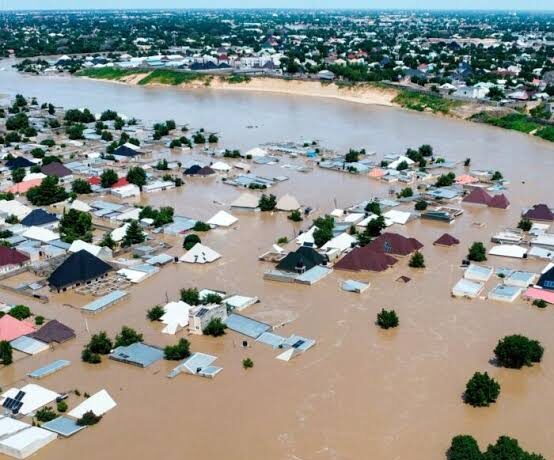
The Federal Government has warned that more than 8,000 communities and 4,500 schools across 15 states are exposed to a heightened risk of flooding as rising river levels threaten homes, healthcare facilities, markets, places of worship and farmlands.
The warning was contained in the latest National Flood Advisory issued by the Nigeria Hydrological Services Agency, NiHSA, covering the period from September 19 to 25.
NiHSA Director-General and Chief Executive Umar Mohammed warned that rising river levels could trigger flooding across vulnerable communities and urged state governments to begin moving people in high-risk areas to safer locations before conditions deteriorate.
The states covered by the warning are Imo, Cross River, Delta, Ebonyi, Benue, Anambra, Akwa Ibom, Edo, Enugu, Bayelsa, Kogi, Abia, Taraba, Rivers and Lagos.
Residents Told to Move to Higher Ground
The Federal Government’s hydrological agency advised people living on floodplains to prepare to relocate to higher ground where necessary.
The warning is particularly important because riverine flooding can develop differently from the flash floods frequently experienced after intense rainfall.
Water levels can rise as rivers receive runoff from large catchment areas, meaning communities may face flooding even when heavy rainfall is occurring some distance away.
NiHSA specifically identified monitoring stations along vulnerable waterways, including Obubra, Itigidi and Epento on the Cross River, where rising river stages are being closely watched.
The advisory provides state and local governments with an opportunity to undertake preventive evacuation rather than waiting until communities are already inundated.
Imo Has More Than 1,000 Schools Exposed
The potential impact on public infrastructure is substantial.
In Imo State alone, NiHSA identified 958 communities, 1,022 schools, 553 healthcare facilities, 161 markets and 198 religious buildings as exposed.
Areas considered vulnerable include Aboh-Mbaise, Ahiazu-Mbaise, Ehime Mbano, Ezinihitte, Ideato North, Ihitte/Uboma and Ikeduru local government areas.
The numbers illustrate why flood disasters can quickly become more than housing emergencies.
When schools are submerged, education is interrupted.
When health centres become inaccessible, communities can lose access to treatment precisely when flood-related disease risks are increasing.
Markets and farms can also be affected, creating consequences for local food supplies and household incomes.
Cross River, Ebonyi Face Significant Exposure
Cross River is another major area of concern.
NiHSA identified 2,471 communities, 703 schools, 344 healthcare facilities, 145 markets and 453 religious buildings, alongside about 854 hectares of farmland, as exposed to the forecast flood risk.
Affected local government areas include Abi, Akamkpa, Akpabuyo, Biase, Calabar, Calabar South, Ikom and Obubra.
The figures are even higher for communities in Ebonyi.
The agency identified 2,574 communities, 1,064 schools, 422 healthcare facilities, 480 markets and 629 religious buildings as vulnerable, along with approximately 1,882 hectares of farmland.
Abakaliki, Afikpo, Afikpo South, Ebonyi, Ezza North and Ezza South are among the affected local government areas.
Anambra Records Heavy Infrastructure Exposure
Anambra’s warning is particularly significant for critical public infrastructure.
NiHSA identified 1,314 communities and 1,308 schools as exposed.
It also listed 1,089 healthcare facilities, 280 markets, 610 religious buildings and approximately 1,529 hectares of farmland as potentially vulnerable.
The affected local government areas include Aguata, Anambra East, Anambra West, Anaocha, Awka North, Awka South and Ayamelum.
In Benue, the agency identified 303 communities, 100 schools and 48 healthcare facilities among the exposed assets, while several local government areas in Akwa Ibom are also covered by the warning.
Flooding Threatens Food Production
The agricultural exposure deserves particular attention.
Flooding can destroy crops shortly before harvest, wash away livestock and damage rural roads used to transport produce to markets.
For Nigeria, where food prices remain an important household concern, significant agricultural losses could have consequences extending far beyond the communities directly affected.
The states included in the warning contain important agricultural areas producing rice, cassava, yam, vegetables and other staples.
Repeated flooding can also make farmers reluctant to invest in the next planting season if previous crops and equipment are lost.
Early Warning Must Become Early Action
Nigeria has experienced devastating floods in previous years, and one recurring challenge has been translating weather and hydrological forecasts into timely local action.
A federal warning can identify where the danger exists.
But evacuation centres, emergency transportation, drainage clearing and community mobilisation largely require coordination between federal agencies, state governments and local authorities.
The latest advisory therefore places significant responsibility on the affected states.
Residents must receive warnings early enough to act, while governments need to identify safe locations for people who cannot simply relocate on their own.
With more than 8,000 communities and 4,500 schools potentially exposed, the immediate priority is preventing a forecast from becoming another large-scale humanitarian emergency.
The Federal Government has provided the warning. The next test is whether authorities at every level can convert that information into evacuations, preparedness and protection before the water arrives.