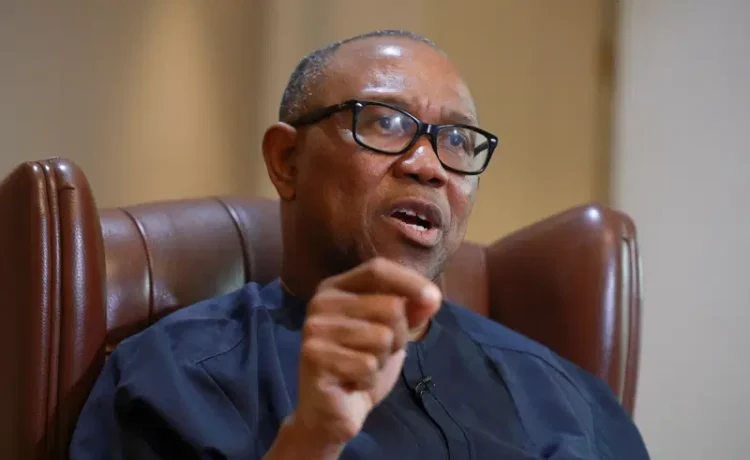
The presidential candidate of the Nigeria Democratic Congress (NDC), Peter Obi, has outlined his strategy to transform Nigeria from a consumption-driven economy into a production-led one, saying agriculture, manufacturing and support for small businesses would drive economic growth if elected president.
Speaking during an exclusive interview on Sunday Politics, Obi said Nigeria has the land, natural resources and human capital to become one of the world’s leading food producers and exporters but has failed to maximise its potential.
According to him, sustainable economic growth, job creation and poverty reduction can only be achieved by increasing local production instead of depending heavily on imports.
“The only way to pull Nigeria out of poverty, or even genuinely grow GDP, is through production, not consumption. That production starts with agriculture, which gives you the food you need, raw materials for your factories, and jobs. That’s a win-win,” he said.
Obi argued that Nigeria could produce enough food to feed its population and generate more revenue from agriculture than crude oil if adequate investments are made.
He said the country has vast areas of uncultivated land that could significantly boost food production and exports.
Using rice as an example, Obi noted that Nigeria currently produces fewer than 10 million tonnes of unmilled rice annually, blaming years of cheap food imports for weakening local farmers.
“We’ve used cheap importation to kill our farmers. We can do more,” he said.
The former Anambra State governor compared Nigeria’s agricultural performance with Bangladesh, noting that despite its smaller land mass, the Asian country produces between 15 million and 16 million tonnes of unmilled rice annually.
He said Nigeria, with its larger expanse of arable land, has the capacity to surpass that level of production.
Obi also cited the Netherlands as an example of how agriculture can become a major source of national income.
According to him, the European country generates more than €120 billion annually from agricultural exports despite occupying a land area much smaller than Nigeria’s Niger State.
He added that countries such as Morocco, Ethiopia and Kenya have successfully built thriving agricultural export industries.
Obi noted that Ethiopia earns more than $1 billion annually from coffee exports, while Kenya generates substantial revenue from flower exports.
He stressed that improving security is essential to unlocking Nigeria’s agricultural potential.
According to him, many fertile farming communities remain underutilised because of insecurity.
Using Niger State as an example, Obi said the state possesses enormous agricultural potential but is currently affected by terrorist activities.
He also referenced the Sambisa Forest, arguing that the area should be viewed as an economic asset once security is restored.
Obi further highlighted the Mambilla Plateau in Taraba State as an ideal location for cultivating tea and coffee capable of competing in international markets.
The NDC presidential candidate said agriculture alone would not be enough to transform the economy unless it is linked to manufacturing.
He explained that expanding agricultural production would provide raw materials for local industries, increase exports and create millions of jobs.
According to Obi, Nigeria must develop a strong manufacturing base rather than continue exporting raw materials.
He added that government should focus on creating an enabling environment for businesses instead of directly engaging in production.
“I never said government would produce. We will encourage the private sector, entrepreneurship and small businesses,” he said.
Obi described small businesses as the largest employers in successful economies around the world.
Drawing lessons from Indonesia, he said about 90 per cent of jobs in the country are created by small businesses supported by affordable government-backed financing.
He also cited China, where small businesses account for roughly 60 per cent of total employment and as much as 80 per cent of urban jobs.
Obi argued that Nigeria must provide affordable financing, business training and a stable operating environment to unlock similar economic growth.
Responding to questions on food imports, Obi said he would not impose a ban until domestic production is strong enough to meet local demand.
He pointed to countries such as India and Vietnam, which successfully transitioned from food importers to major rice producers through sustained investment in local agriculture.
Obi acknowledged that rebuilding Nigeria’s economy would take time but insisted that visible progress would restore public confidence.
He said genuine reforms, backed by consistent implementation, would give Nigerians hope and lay the foundation for long-term economic prosperity.