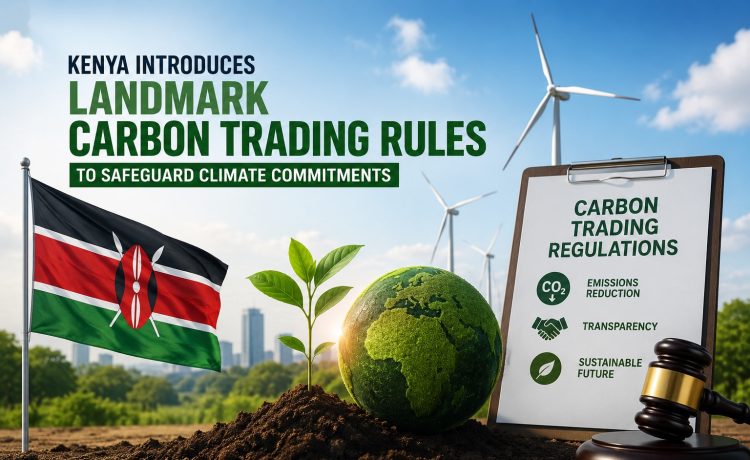
Kenya has introduced a comprehensive framework to regulate international carbon trading, becoming one of the first African countries to place a cap on the volume of carbon credits it can sell abroad.
The move is designed to protect the country’s climate commitments while creating a more transparent and credible carbon market that attracts responsible investment.
Government officials say the new framework aligns Kenya’s climate policies with Article 6 of the Paris Agreement, which establishes international rules for carbon markets and encourages countries to cooperate in reducing greenhouse gas emissions.
The regulations represent a significant milestone in Kenya’s climate governance and are expected to strengthen the country’s position as a leader in Africa’s emerging carbon economy.
Under the new policy, Kenya will authorise the sale of no more than 10 million metric tonnes of carbon dioxide equivalent through international carbon trading programmes between now and 2030.
To ensure the cap is maintained, annual carbon credit allocations will be limited to approximately 1.67 million metric tonnes.
Officials say the restrictions are intended to prevent the country from selling too many emissions reductions that may be required to achieve its own national climate targets.
Carbon credits are generated when projects successfully reduce, remove or avoid greenhouse gas emissions. These credits can be sold to governments or companies seeking to offset part of their own emissions as they work toward climate goals.
Over the past decade, Africa has become an increasingly attractive destination for carbon investment due to its vast renewable energy potential, conservation projects and nature-based climate solutions.
However, climate experts have cautioned that countries must strike a balance between attracting international finance and preserving sufficient emissions reductions to meet domestic obligations under the Paris Agreement.
Kenya’s new framework seeks to address this concern by establishing clear limits on international credit transfers while ensuring national climate priorities remain protected.
In addition to introducing sales caps, the regulations significantly simplify the country’s carbon project approval process.
Previously, developers seeking to establish carbon projects were required to navigate a lengthy three-stage approval system that many investors considered slow and bureaucratic.
The revised framework replaces that process with clearer decision-making criteria designed to reduce delays, improve efficiency and provide greater certainty for project developers.
Government officials believe the reforms will make Kenya’s carbon market more competitive while maintaining strong environmental safeguards.
The framework also identifies priority sectors eligible for carbon market participation.
These include renewable energy, transportation and waste management, all of which are regarded as critical to reducing greenhouse gas emissions while supporting sustainable economic development.
For the time being, forestry and land-use projects have been excluded from international carbon trading under the new regulations.
Officials say additional guidelines for these sectors may be introduced in the future following further consultations and technical assessments.
The decision reflects the government’s cautious approach to ensuring environmental integrity and avoiding unintended impacts on land management and biodiversity conservation.
Environmental analysts say Kenya’s latest reforms could enhance investor confidence by providing greater transparency and regulatory certainty.
International investors increasingly favour jurisdictions with well-defined legal frameworks that reduce uncertainty and ensure carbon credits meet internationally recognised standards.
By clarifying project eligibility, approval procedures and trading limits, Kenya hopes to attract high-quality climate investments capable of supporting long-term sustainable development.
The framework is also expected to improve accountability by strengthening oversight of carbon transactions and ensuring environmental benefits are accurately measured and verified.
Supporters argue that these measures will enhance the credibility of Kenya’s carbon market while protecting the country’s reputation within the global climate finance community.
Climate finance has become an increasingly important source of funding for developing countries seeking to accelerate renewable energy deployment, improve waste management systems and strengthen climate resilience.
Kenya has consistently positioned itself as one of Africa’s leading advocates for climate action, investing heavily in geothermal energy, wind power and other renewable technologies.
The country already generates a significant proportion of its electricity from renewable sources, making it one of the continent’s clean energy leaders.
Officials believe the new carbon trading framework complements these achievements by creating additional opportunities to mobilise private sector investment for environmentally sustainable projects.
Nevertheless, some environmental organisations have urged continued vigilance in implementing the regulations.
They argue that strong monitoring systems, transparent reporting and effective enforcement will be essential to ensuring carbon trading delivers genuine environmental benefits rather than becoming a purely financial exercise.
Experts also stress the importance of ensuring that local communities hosting carbon projects receive fair economic benefits and are actively involved in project planning and implementation.
As global demand for high-quality carbon credits continues to grow, Kenya’s regulatory reforms could serve as a model for other African countries seeking to develop credible carbon markets without compromising national climate objectives.
The new framework demonstrates Kenya’s determination to balance economic opportunity with environmental responsibility while strengthening its contribution to global efforts to combat climate change.
If successfully implemented, the policy could reinforce the country’s reputation as a regional leader in climate governance and sustainable development.