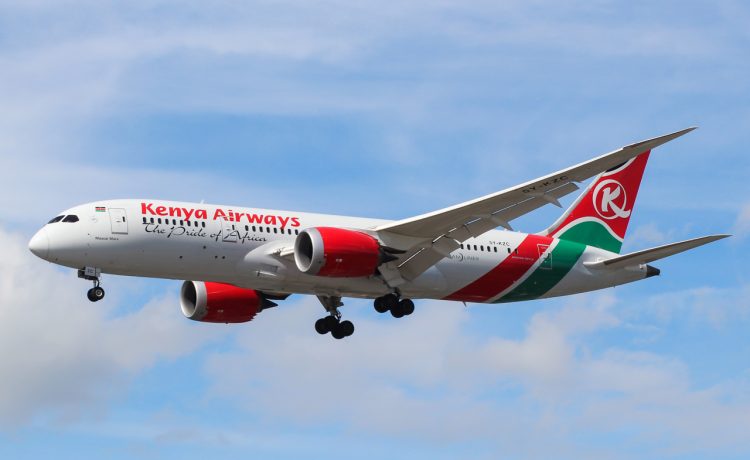
Kenya Airways has reported a significant increase in its first-half loss despite achieving stronger revenue, highlighting the financial pressures facing airlines as fuel costs, aircraft availability and geopolitical disruptions continue to affect the industry.
The airline’s net loss for the six months to June 2026 increased by 31.9 percent to approximately Sh16 billion, compared with Sh12.2 billion in the same period of 2025.
At the same time, revenue increased by 9 percent to Sh81.2 billion from Sh74.5 billion.
The results demonstrate a difficult reality for the airline.
Demand is improving, but Kenya Airways does not currently have enough operational capacity to fully take advantage of that demand.
Fuel costs become a major burden
One of the biggest problems facing Kenya Airways is fuel.
The airline’s fuel bill increased dramatically during the period.
Fuel costs reached about Sh29 billion, representing roughly 32 percent of operating costs.
That was a 66 percent increase from approximately Sh17.47 billion during the corresponding period a year earlier.
The increase was linked partly to disruption caused by the Middle East conflict.
Higher global fuel prices create immediate pressure for airlines because fuel is one of their largest operating expenses.
Even when ticket sales increase, higher fuel costs can absorb much of the additional revenue.
Revenue growth offers some encouragement
Despite the losses, there are positive signs.
Passenger demand has remained relatively strong.
Kenya Airways’ revenue rose 9 percent during the first half of the year.
The airline also benefited from changing travel patterns as disruptions in the Middle East caused some international travellers to reroute through African destinations.
Its overall load factor improved by 3.9 percentage points to 76.3 percent.
Load factor measures the percentage of available seats occupied by paying passengers.
A higher load factor is generally positive because it indicates stronger demand.
Aircraft shortages limit growth
The biggest challenge is therefore not simply demand.
Kenya Airways is experiencing a capacity problem.
Several aircraft have been unavailable because of maintenance requirements and difficulties obtaining spare parts.
Two Boeing 787 Dreamliners and Boeing 737 aircraft were among those affected, while some Embraer aircraft used for regional services also faced availability challenges.
Aircraft maintenance is essential for aviation safety.
However, when planes remain grounded for extended periods, airlines lose the ability to sell seats on those aircraft.
That creates a difficult financial situation.
The airline continues to incur certain fixed costs while losing potential revenue.
Strong routes remain attractive
Some of Kenya Airways’ international routes continue to demonstrate strong demand.
The airline recorded load factors above 90 percent on important long-haul routes including London and New York.
This suggests that there is significant potential for revenue growth if the airline can restore sufficient aircraft capacity.
The problem is therefore converting existing demand into additional flights.
Cargo provides another opportunity
Kenya Airways is also increasingly relying on cargo and maintenance services to diversify revenue.
Cargo revenue increased 18 percent to approximately Sh8.8 billion during the period.
That represented about 11 percent of total revenue.
Cargo can be particularly important for an African airline because Nairobi is an important regional logistics hub.
Kenya’s agricultural exports, particularly flowers and fresh produce, require efficient air transport to international markets.
What happens next?
Kenya Airways needs to restore profitability while dealing with global aviation challenges.
The airline must secure aircraft availability.
It must control costs.
It must protect its strongest routes.
And it must continue expanding alternative revenue streams.
The results show that there is demand for Kenya Airways’ services.
The bigger challenge is operational efficiency.
If the airline can solve its capacity problems and stabilise fuel costs, stronger revenue could eventually translate into improved profitability.
For now, however, the Sh16 billion loss demonstrates that Kenya Airways remains under considerable financial pressure.