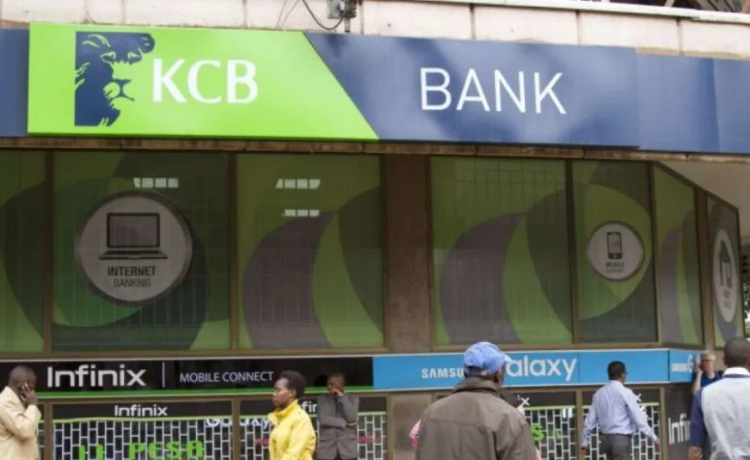
Kenya Commercial Bank has asked the country’s Directorate of Criminal Investigations to investigate documents connected to a legal dispute involving approximately Sh146.3 billion allegedly transferred from abroad for investment in government bonds.
KCB says documents submitted in court by Foxcapital Investment Ltd are fraudulent and has asked investigators to determine who prepared, supplied or presented the documents.
The dispute has placed a major financial transaction under scrutiny while the High Court considers competing claims over whether the funds were received by the bank.
How the dispute began
Foxcapital claims that approximately €978.7 million, equivalent to about Sh146.3 billion, was transferred into a KCB account in October 2025.
The company says the money was intended for investment in government securities.
Foxcapital subsequently went to court after alleging that KCB received the money but failed to credit its account.
The High Court has preserved the funds while the dispute is being examined.
KCB challenges the evidence
KCB has strongly disputed the claim.
The bank has asked its internal systems to be examined and says it found no record corresponding to the alleged transaction.
It also contacted UBS Switzerland AG, which was allegedly connected to the transfer documentation.
According to KCB’s complaint, UBS informed the bank that documents attributed to the Swiss institution were not genuine.
That response has become central to KCB’s request for a criminal investigation.
The documents under scrutiny
KCB has challenged several documents used by Foxcapital to support its case.
These reportedly include SWIFT messages, an incident report and financial-crime and technical review documents.
The bank says the documents contain irregularities.
KCB’s position is that the alleged transaction cannot be found in its systems and that UBS has denied originating the relevant documents.
Foxcapital’s position
Foxcapital has maintained a different account.
Its chief executive, David Dudi Akech, told the court that KCB’s internal records showed the funds had entered a pre-settlement suspense account.
He also relied on documents that he said demonstrated that the transaction had been investigated internally.
Those documents allegedly included a system incident report and a financial-crime review.
The company therefore disputes KCB’s assertion that the money was never received.
Why the dispute matters
A transaction of this size is significant for Kenya’s financial sector.
Government bonds are among the country’s most important financial instruments.
Large institutional investments can influence liquidity and the broader capital market.
A dispute involving more than Sh146 billion therefore attracts attention beyond the parties directly involved.
It also raises questions about transaction verification, international remittances and banking controls.
Importance of international banking systems
Cross-border transactions depend heavily on reliable messaging and verification systems.
Banks must be able to confirm where money originated, who authorised a transfer and whether instructions are genuine.
Fraudulent documentation can create enormous risks.
Financial institutions therefore maintain extensive compliance procedures.
The KCB dispute demonstrates why those systems matter.
What investigators could determine
The DCI investigation, if undertaken, could help establish whether the documents were fabricated.
Investigators may examine electronic records, correspondence, bank systems and communications between the parties.
They could also establish whether the alleged transfer actually occurred.
That evidence could eventually influence the court case.
A financial-sector test
The dispute is now both a legal and financial-sector issue.
Banks need strong systems to prevent fraud.
Customers need confidence that legitimate transfers will be processed correctly.
Courts need reliable evidence when resolving disputes involving large sums.
The case is still unresolved, and allegations made by either side should not be treated as established facts.
However, the size of the transaction and the competing claims make it one of Kenya’s more significant banking disputes.