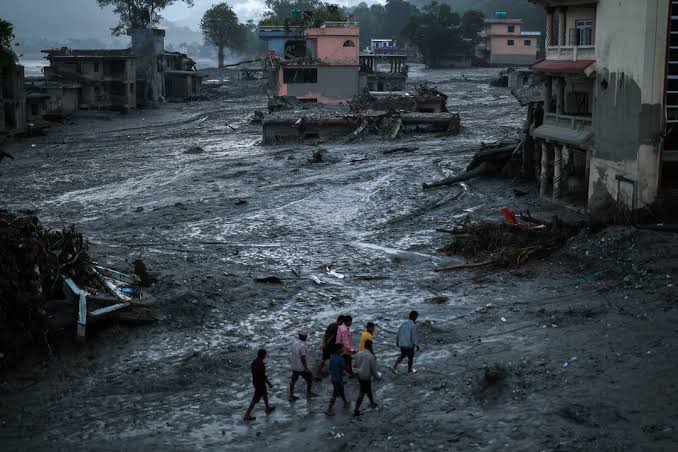
Nepal faces a massive reconstruction challenge after catastrophic flash floods killed more than 1,300 people across Nepal and neighbouring Tibet, destroyed thousands of homes and caused an estimated $2.56 billion in damage.
About 5,000 people remain missing across the affected region, while rescue workers continue searching areas devastated by the August 26 disaster.
Around 7,500 homes have been destroyed and at least 12 hydropower projects damaged, threatening communities as well as infrastructure vital to Nepal’s electricity supply and economy.
The estimated $2.56 billion damage bill is equivalent to nearly one-fifth of Nepal’s roughly $14 billion annual government budget, illustrating the scale of the financial challenge confronting Kathmandu.
New Government Faces Major Test
The disaster represents an early and difficult test for Prime Minister Balendra “Balen” Shah.
Shah, a former rapper, structural engineer and Kathmandu mayor, became Nepal’s youngest prime minister in March after his Rastriya Swatantra Party secured a landslide parliamentary victory.
His rise followed months of political turmoil and youth-led protests that helped reshape Nepal’s political landscape.
The 36-year-old prime minister entered office promising political change and reform, but his relatively inexperienced administration must now coordinate one of the largest rescue and reconstruction operations in the country’s recent history.
Anger Grows Over Rescue Response
The disaster has also generated criticism of the government’s emergency response.
Nepal observed a national day of mourning as families remembered those killed in the floods, while demonstrations were held in Kathmandu over the pace of rescue operations.
About 900 of those missing were workers at hydropower sites, with hundreds believed to have been trapped in tunnels.
International teams from countries including China, India, South Korea and the United States have participated in rescue efforts.
The complexity of the terrain, damaged roads and destroyed infrastructure has made some affected areas extremely difficult to reach.
Glacier Collapse Under Investigation
The disaster began when part of a glacier high in the Himalayas collapsed, sending ice, rocks, water and debris into river systems along the Nepal-Tibet border.
The resulting flood swept through communities, destroyed bridges and roads and caused river levels to rise rapidly downstream.
Scientists are investigating the factors that caused the collapse.
While the Himalayas are experiencing rapid warming and glacial loss, researchers have cautioned that a direct link between climate change and this specific collapse has not yet been conclusively established.
The broader vulnerability is nevertheless clear.
Nepal contributes only a small fraction of global greenhouse gas emissions but is highly exposed to glacial floods, landslides and other climate-related hazards because of its mountainous geography.
Reconstruction Could Take Years
The economic consequences could extend well beyond the immediate disaster.
Hydropower is a critical component of Nepal’s energy system, while tourism provides jobs, foreign exchange and income for communities across the Himalayan country.
Damage to roads, bridges, power facilities and tourism infrastructure could therefore affect economic activity long after rescue operations end.
The scale of the losses is also likely to increase pressure for international financial support and greater investment in climate-resilient infrastructure.
For Shah’s government, the challenge is consequently twofold: respond to the immediate humanitarian crisis while developing a reconstruction programme capable of restoring infrastructure and reducing vulnerability to future disasters.