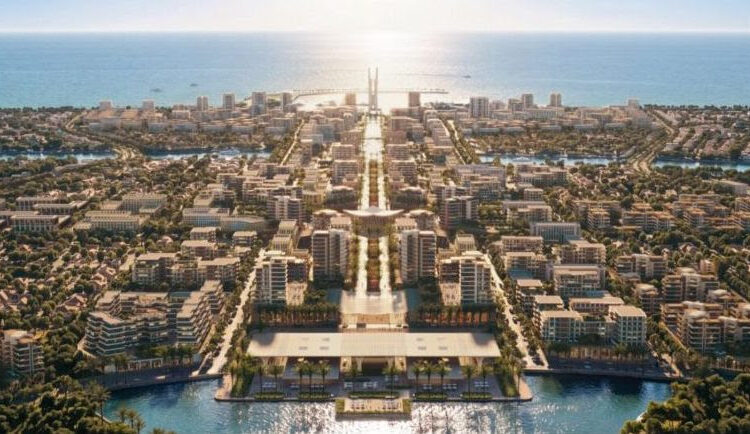
Architecture and urban planning firm SOM has unveiled a 20.6-square-kilometre master plan for Alam Al Roum, a proposed coastal development along Egypt’s Mediterranean shoreline near Marsa Matrouh, with climate-responsive infrastructure and sustainable urban design at the centre of the project.
Commissioned by developer Qatari Diar, the proposed city is designed to combine residential neighbourhoods, tourism facilities, commercial districts and public spaces while responding to the environmental challenges associated with coastal development.
A central feature of the master plan is a network of 22 kilometres of swimmable lagoons connected to seawater, designed to support recreational activities while contributing to the management of stormwater across the development.
According to SOM, the design takes into account the region’s climatic conditions and the potential effects of changing coastal environments, with particular attention to heat management, water systems and long-term resilience.
Buildings and public spaces will be positioned to maximise access to natural sunlight and sea breezes, reducing reliance on energy-intensive cooling systems and improving outdoor comfort.
The development will also incorporate natural coastal protection measures, including wetlands, stabilised dunes and living shorelines, intended to strengthen the site’s resilience against coastal erosion, flooding and other environmental pressures.
The proposed city will feature several interconnected districts, including beachfront residential neighbourhoods, town centres, resorts, golf facilities, an education district and a dedicated business hub.
These components are expected to create a mixed-use urban environment that combines residential living, hospitality, leisure, education and commercial activities.
A major boulevard will connect the marina to an inland mobility hub, providing an important transportation link between the waterfront and other parts of the development.
The downtown waterfront is also expected to accommodate a cultural pier, lighthouse and amphitheatre, creating public spaces for entertainment, cultural activities and tourism.
The project reflects a broader shift in international architecture and urban planning towards developments that integrate environmental considerations into large-scale infrastructure and real estate projects.
Coastal cities face increasing exposure to environmental risks, including rising temperatures, changing sea levels, storm surges and shoreline erosion. These challenges have made climate adaptation an important consideration for governments, developers and urban planners.
By incorporating natural coastal barriers and climate-responsive building designs, the Alam Al Roum master plan seeks to demonstrate how large-scale tourism and residential developments can incorporate environmental resilience into their planning.
The development could also strengthen Egypt’s coastal tourism infrastructure and attract investment into hospitality, real estate, retail and related services.
However, the long-term environmental and economic impact will depend on how effectively the proposed safeguards are implemented, particularly in relation to water management, biodiversity protection and the preservation of coastal ecosystems.