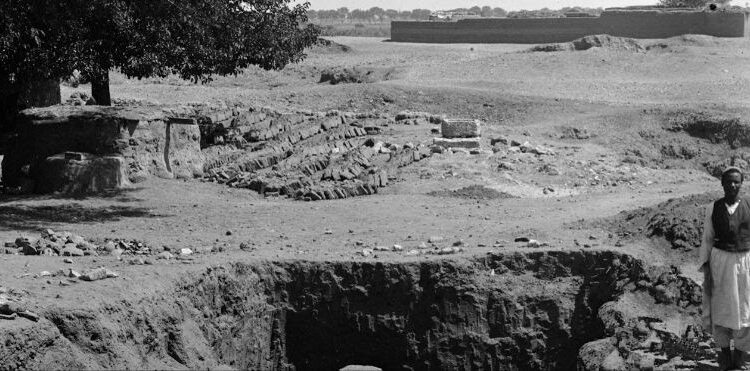
A new examination of nearly 3,000 ancient flint tools excavated from Egypt’s Heliopolis settlement has provided evidence that specialised manufacturing and craft production existed in farming communities before the unification of the Nile Valley under the first pharaohs.
The findings offer fresh insight into the economic and social organisation of early Egyptian communities, suggesting that specialised production and the exchange of goods were already developing before the emergence of a centralised Egyptian state.
The collection, originally excavated in 1905 and 1906, was recently re-examined by researchers seeking to understand how ancient communities produced and distributed everyday tools.
The artefacts included finished flint tools, stone cores, flakes and manufacturing debris, allowing researchers to reconstruct the different stages involved in producing blades.
Dating to shortly before 3000 BCE, the materials point to the existence of a specialised workshop where skilled craftspeople produced flint blades in quantities exceeding the immediate needs of their own households.
Researchers also identified evidence of a nearby brewery area that relied on the manufactured blades, suggesting that different activities within the settlement were connected through the exchange and use of specialised tools.
The findings indicate that some members of the community concentrated on producing tools while others depended on their output for activities such as food processing and brewing.
This pattern suggests that occupational specialisation and economic interdependence were developing within agricultural settlements before Egypt emerged as a unified political entity.
The discovery is particularly significant because it provides evidence that early Egyptian communities had already developed systems of production and distribution that extended beyond individual household needs.
Researchers believe these existing economic relationships may have helped communities adapt when standardised blades produced in larger workshops later began replacing locally manufactured tools.
Rather than representing an entirely new economic arrangement, the transition may have built on established practices in which communities relied on specialised producers for essential equipment.
The findings therefore contribute to a broader understanding of how economic organisation, technological development and social relationships evolved in ancient Egypt.
The transition from locally produced tools to standardised manufacturing is also important for understanding the development of larger production systems and the emergence of more complex economic structures.
By revisiting museum collections excavated more than a century ago, researchers are demonstrating how modern archaeological analysis can uncover new information from artefacts that have remained preserved in collections for generations.
The Heliopolis findings add to growing archaeological evidence that technological innovation and economic specialisation were important features of Egyptian society even before the establishment of its early dynasties.