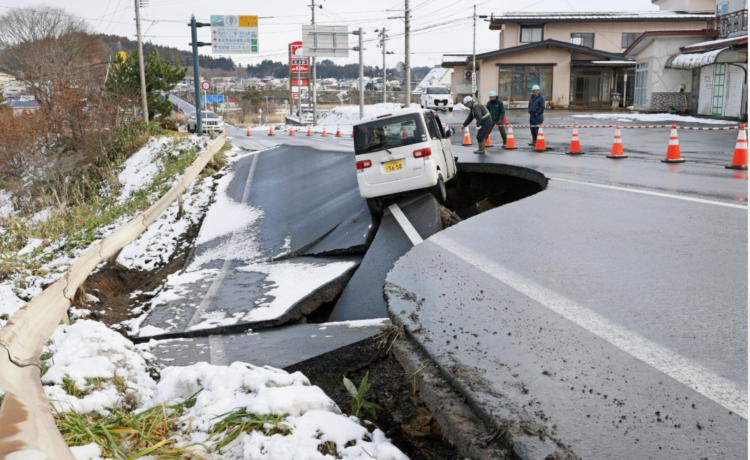
An earthquake has renewed attention to seismic safety in Japan, a country that regularly experiences earthquakes because of its location along several active tectonic plate boundaries.
A Reuters report available in a news archive described a magnitude 6.1 earthquake jolting northern Japan. The report identified the Japan Meteorological Agency as the source of the preliminary magnitude assessment.
However, the available report did not establish that the earthquake caused 76 injuries on October 23. That figure should not be published as a confirmed fact without further authoritative reporting.
Why Japan experiences earthquakes
Japan sits near the boundaries of several tectonic plates, where the movement of Earth’s crust generates seismic activity. Earthquakes can occur offshore or beneath populated areas, sometimes producing strong ground shaking.
The country’s geographical position makes earthquake monitoring an essential part of public safety. Scientists use seismic instruments to detect ground movement, estimate an earthquake’s magnitude and determine its location and depth.
These assessments help authorities evaluate potential hazards and decide whether additional warnings are necessary.
Emergency preparedness remains essential
Japan has developed extensive earthquake-preparedness systems, including building standards, public alerts and emergency procedures. Residents are encouraged to understand evacuation routes, secure heavy furniture and keep essential supplies available.
During strong shaking, people indoors are generally advised to drop, cover and hold on, staying away from windows and objects that could fall. Following an earthquake near the coast, people should pay attention to official tsunami warnings and evacuate coastal areas when instructed.
Emergency authorities must also assess roads, railways, electricity networks and other infrastructure after significant tremors.
Economic and infrastructure implications
Earthquakes can disrupt transportation, manufacturing and commercial activity even when structural damage is limited. Railway services may be suspended while operators inspect tracks and infrastructure. Factories may pause operations to protect workers and check equipment.
More serious events can cause extensive damage to homes, businesses, roads and public utilities, creating large reconstruction costs.
For businesses, preparedness plans can reduce disruption by identifying alternative suppliers, protecting important records and establishing procedures for staff safety.
The importance of accurate information
Initial earthquake reports are often based on preliminary measurements. Magnitude estimates, casualty figures and assessments of damage can change as authorities gather more information.
News organisations should therefore distinguish confirmed details from early reports and avoid publishing casualty figures that cannot be independently supported.
The earthquake report reinforces the importance of monitoring seismic activity and maintaining effective emergency procedures. Japan’s experience demonstrates how preparedness, reliable public communication and resilient infrastructure can help communities manage the risks posed by earthquakes.