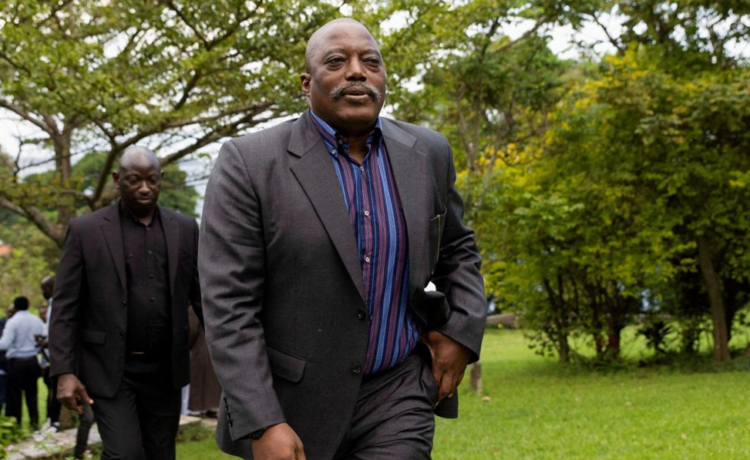
Former Democratic Republic of Congo president Joseph Kabila has announced a new political-military coalition that includes the M23 armed movement, a development that could reshape the country’s continuing conflict.
The alliance, known as the Front for the Refoundation of the Nation (FRN), was announced at a news conference in Goma, a major city in eastern DR Congo that has been under M23 control since January 2025.
According to reporting by Al Jazeera, AFP and AP, Kabila will lead the coalition alongside figures associated with the Congo River Alliance, known by its French acronym AFC, which serves as the political umbrella for M23.
Among the figures expected to play leading roles are AFC head Corneille Nangaa and M23 military commander Sultani Makenga.
The announcement represents a significant development because Kabila, who governed the country from 2001 to 2019, has now taken a more direct public role in a political-military movement linked to the insurgency.
The coalition’s emergence comes as the Congolese government continues to face a difficult security situation in the east, where fighting has displaced communities and complicated efforts to restore government authority.
A conflict with deep regional roots
Eastern DR Congo has experienced repeated cycles of armed conflict involving local armed groups, national forces and regional interests.
The region contains valuable mineral resources, including minerals used in electronics and other industrial products. Competition over territory, political authority and access to resources has contributed to the complexity of the conflict.
M23 has captured significant territory in the east, including Goma and Bukavu, according to recent reporting. Its military advances have created serious humanitarian and security concerns.
The Congolese government, the United States and United Nations experts have accused Rwanda of supporting M23. Rwanda denies the allegations.
The dispute has strained relations between Kinshasa and Kigali and complicated attempts to negotiate a lasting settlement.
Kabila’s new coalition adds another political dimension to the crisis. It brings a former head of state into a more direct alliance with a movement fighting the current government, potentially changing calculations among political leaders, military commanders and outside mediators.
Kabila’s political background
Kabila became president in 2001 following the assassination of his father, Laurent-Désiré Kabila. He remained in office until 2019, when Félix Tshisekedi succeeded him.
His political legacy remains contested. Supporters and opponents have different assessments of his years in power, while the relationship between the former president and the current administration has become increasingly hostile.
In September 2025, a Congolese military court sentenced Kabila to death in absentia after convicting him on charges including treason and other serious offences linked to the conflict. Kabila has described the case as politically motivated and denies the accusations.
The United States has also imposed sanctions on him over his alleged role in supporting rebel groups.
These circumstances make the new alliance especially significant. It could deepen the confrontation between Kabila and Tshisekedi while raising questions about how the government will respond to the coalition’s political and military ambitions.
The legal proceedings and allegations against Kabila must be distinguished from independently established facts about his current activities. His announcement of the coalition, however, is a concrete political development with potential consequences for the conflict.
Possible effects on peace negotiations
The announcement could complicate diplomatic initiatives aimed at ending the fighting.
Negotiations require parties to agree on who represents each movement, what commitments can be made and how any settlement will be implemented. A new alliance may change the composition of negotiating groups and create uncertainty over existing arrangements.
Reports have indicated that representatives of the Congolese government and M23 were expected to meet in Qatar in November. The emergence of the FRN could affect those discussions, although its precise impact will depend on the decisions of the parties involved.
If the coalition increases military coordination among its members, government forces could face additional pressure. Conversely, if it develops a coherent political programme and participates in negotiations, it may create a new channel for dialogue. Neither outcome is guaranteed.
The immediate concern is that the announcement could encourage further confrontation before diplomatic efforts have had time to produce results.
Humanitarian consequences
The greatest cost of continued fighting is likely to fall on civilians.
Armed conflict can force families to flee their homes, interrupt education and restrict access to healthcare, food and clean water. Communities living near front lines may face particular danger, while displaced people often struggle to find safe shelter and employment.
The conflict also threatens local commerce and the movement of essential goods. When roads, border crossings or transport networks become unsafe, the cost of delivering humanitarian supplies can rise.
Aid organisations require secure access to affected populations and guarantees that civilians and humanitarian personnel will not be deliberately targeted.
Any new military escalation would therefore raise concerns not only about territorial control but also about civilian protection and the ability of relief agencies to operate.
What happens next?
The coalition’s next steps will help determine whether it becomes primarily a political organisation, a mechanism for coordinating armed activity or a combination of both.
The Congolese government may seek diplomatic support, strengthen its security response or pursue legal measures against individuals associated with the alliance. Regional governments and international partners will also be under pressure to prevent the conflict from spreading.
A sustainable settlement would need to address security concerns, political representation, accountability and the return of displaced people. It would also require commitments that can be monitored and implemented.
Kabila’s announcement marks an important change in the political landscape, but it does not by itself determine the outcome of the conflict.
For people living in eastern Congo, the central question is whether the development will bring renewed fighting or create conditions for a negotiated solution. Until there is clearer evidence of a workable peace process, concerns about instability are likely to remain high.