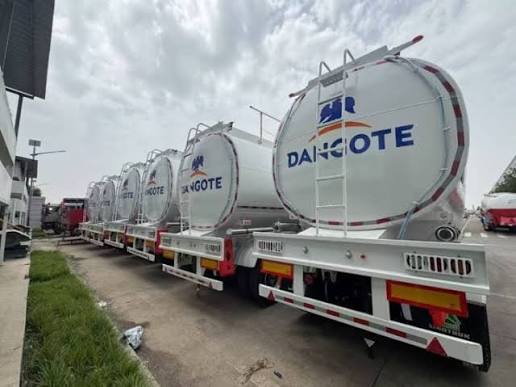
Dangote Petroleum Refinery and Petrochemicals has expanded its free petroleum product delivery initiative to additional Nigerian states in a move aimed at reducing distribution costs and improving efficiency in the downstream oil sector.
The initiative has now been extended to Kano, Imo, Anambra and Nasarawa, in addition to locations previously covered, including Lagos, Ogun, Rivers, Kaduna, Abuja and Delta.
The refinery says the programme is designed to bring petroleum products closer to independent marketers and retailers.
By reducing the cost of transporting products over long distances, the initiative could help businesses manage their operating expenses more efficiently.
Distribution remains a major cost
Nigeria’s downstream petroleum market has undergone major changes since the removal of the petrol subsidy.
Although deregulation has allowed market forces to play a larger role, logistics remain an important component of the final price consumers pay for petroleum products.
Transporting petrol from coastal refining and storage locations to distant markets requires significant financial resources.
Marketers also have to manage working capital while waiting for products to be loaded and delivered.
The Dangote initiative seeks to address part of that challenge.
Impact on marketers
Fatima Aliko Dangote, Group Executive Director for Commercial Operations, Oil & Gas, WAEP and Fertiliser, said the objective is to ensure that the benefits of domestic refining translate into practical savings for businesses and consumers.
For marketers, lower transportation costs can have a direct impact on cash flow.
When businesses spend less on logistics, they can potentially deploy more capital towards inventory, retail expansion and other operational needs.
The initiative could therefore have implications beyond petrol prices.
Potential impact on consumers
Consumers are also expected to benefit if the savings generated through distribution efficiencies are passed through the supply chain.
However, the final impact on pump prices will depend on several other factors.
These include international crude oil prices, exchange rates, taxes, operating costs and market competition.
Therefore, free delivery alone will not determine petrol prices.
Nevertheless, reducing one major cost component could improve the efficiency of the downstream market.
Competition and deregulation
The Independent Petroleum Marketers Association of Nigeria has welcomed the development.
Its National Publicity Secretary and Public Relations Officer, Chinedu Ukadike, described the initiative as a practical demonstration of the benefits of competition and deregulation.
The response highlights a broader change taking place in Nigeria’s petroleum industry.
Domestic refining capacity is increasing the importance of local supply chains.
As more petroleum products are produced domestically, the sector can potentially reduce its exposure to international shipping and import logistics.
However, the success of domestic refining will depend on whether producers can supply products consistently and competitively.
A changing downstream market
Dangote Refinery’s growing role is already reshaping Nigeria’s fuel supply chain.
The refinery has moved from being a major infrastructure project to becoming an increasingly important participant in the domestic petroleum market.
Its distribution strategy could also influence how independent marketers operate.
If logistics become more efficient, smaller businesses may be able to improve their cash flow and inventory management.
Over time, this could contribute to greater competition among fuel retailers.
The broader objective should be to build a downstream petroleum market in which domestic refining, efficient distribution and competition combine to deliver more predictable prices.
For consumers, the most important measure will ultimately be whether these efficiencies translate into more affordable and reliable access to petroleum products.