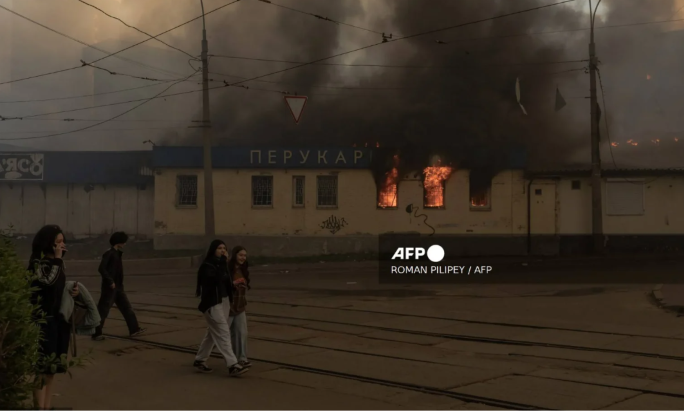
At least 13 people have been killed following a Russian drone strike on a railway station in Ukraine’s Dnipro region, in another deadly attack highlighting the continuing dangers faced by civilians during the prolonged conflict between both countries.
The attack occurred on Thursday, October 29, 2026, when a Russian drone struck a busy railway platform where passenger trains were standing.
Ukrainian President Volodymyr Zelensky condemned the incident, describing it as a horrific attack and calling for continued international pressure on Moscow.
According to a report published by Punch Newspapers on October 29, the drone struck a platform where a regular commuter train and a passenger train were present.
Images released by Ukrainian emergency services showed damaged trains, shattered windows, bodies on the platform and rescue workers assisting victims.
The incident has renewed concerns about the safety of railway transportation in Ukraine, where trains remain an important means of movement for millions of residents.
Civilian transportation under threat
Ukraine’s railway network plays a major role in the country’s transportation system, particularly because of the disruption caused by the ongoing war.
Rail services connect cities across the country and provide an important alternative to road transportation.
However, railway infrastructure has increasingly come under attack since Russia launched its full-scale invasion of Ukraine in February 2022.
The national railway operator has repeatedly faced security challenges as drones and missiles threaten passenger services, railway facilities and other critical infrastructure.
According to information cited in the Punch report, passengers were evacuated from more than 5,800 Ukrainian train services in September alone because of the threat of Russian drone attacks.
The latest incident demonstrates how difficult it has become to maintain ordinary transportation activities in areas affected by the conflict.
The attack also raises questions about the protection of civilians using public transportation facilities.
Railway stations are often crowded with passengers, workers and people travelling for essential reasons, making attacks on such locations particularly dangerous.
Ukraine demands continued international pressure
Following the attack, Zelensky renewed his criticism of moves to ease certain sanctions against Russia.
He argued that sanctions should remain in place for as long as Russian military operations continue against Ukraine.
The Ukrainian President questioned whether easing restrictions on Russian economic activities would encourage Moscow to reduce its attacks.
He also called for international partners to maintain pressure on Russia and support Ukraine’s ability to defend its territory.
The attack occurred amid efforts to maintain a fragile local ceasefire in the city of Oleshky, which has been under Russian occupation since 2022.
Both countries reportedly said the truce was holding into its third day, even as fighting continued in other locations.
Ukraine’s air force said it intercepted three jet-powered drones during the daytime attack, while a fourth reportedly evaded the country’s defences and struck the railway station.
Wider humanitarian consequences
The human cost of the conflict continues to extend beyond military personnel and frontline positions.
Civilians remain exposed to attacks on residential buildings, transportation networks, energy infrastructure and other essential services.
The Punch report also documented other attacks across Ukraine, including incidents in Chernigiv and Kremenchuk that resulted in additional deaths and injuries.
These incidents highlight the continuing humanitarian consequences of the war.
The conflict has also affected economic activities, disrupted supply chains and increased pressure on public infrastructure.
Ukraine and Russia are expected to participate in further discussions under United States mediation, although no firm dates for the proposed talks had been established in the report.
Previous negotiations have failed to produce a lasting settlement, with disagreements over territorial control, security arrangements and political conditions continuing to complicate diplomatic efforts.
The latest railway station attack adds to the urgency of efforts to protect civilians and pursue a sustainable resolution to the conflict.
For Ukraine, protecting public infrastructure remains an important part of national resilience as the war continues.