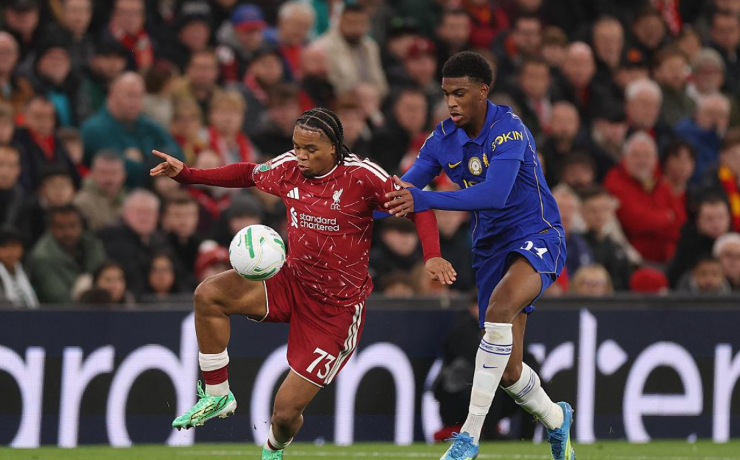
Liverpool defeated Chelsea 6–5 on penalties after the teams played out a 1–1 draw in normal time at Anfield on Wednesday, 28 October 2026, to advance to the quarter-finals of the Carabao Cup.
Liverpool’s official match report described the contest as a dramatic night at Anfield, with the home side eventually progressing after a tense shoot-out.
The match was decided from the penalty spot after neither team could find a winning goal during normal time. Chelsea took the lead through Morgan Rogers in the 40th minute, but Liverpool responded through Cody Gakpo three minutes later.
The equaliser restored parity before half-time and left both sides needing another goal to settle the tie in regulation time. Neither team managed to break the deadlock again, sending the contest to penalties.
Liverpool eventually converted enough of their attempts to win 6–5 in the shoot-out. Joe Gomez scored for the hosts, while Chelsea’s Wesley Fofana missed the decisive opportunity, according to Liverpool’s match report.
A closely contested first half
Chelsea’s opening goal came through Rogers in the 40th minute. Liverpool responded quickly, with Gakpo scoring in the 43rd minute to bring the home side level.
The timing of the two goals meant that the match remained evenly balanced as the teams approached the interval.
For Liverpool, the equaliser was important because it prevented Chelsea from taking a lead into half-time and kept the contest open. Chelsea, meanwhile, had demonstrated an ability to find space and create a scoring opportunity against the home defence.
Cup matches can be difficult to predict because the outcome depends not only on general team quality but also on how players respond to the circumstances of a particular fixture. A single goal can alter the balance of a tie, while a penalty shoot-out places additional pressure on individual players.
The 1–1 scoreline reflected a match in which neither side managed to establish a decisive advantage before the final whistle.
Penalties settle the contest
With the score still level, the match proceeded to penalties. Liverpool won the shoot-out 6–5, allowing the club to continue its campaign in the competition.
A penalty shoot-out tests composure, execution and the ability of players to perform under pressure. Even teams that have competed evenly during normal time can experience very different outcomes once the result depends on a sequence of individual attempts.
Liverpool’s successful penalties ultimately proved enough to settle the contest. Fofana’s miss for Chelsea became the decisive moment highlighted in the club’s match report.
The result ended Chelsea’s involvement in this round of the competition, while Liverpool moved into the quarter-finals.
Importance of the result for Liverpool
Progress in a domestic cup provides clubs with another opportunity to compete for silverware during a demanding season.
Liverpool’s advancement keeps the team in contention for the Carabao Cup title and gives the squad another fixture in the later stages of the tournament.
However, a single cup result does not establish how the remainder of a season will unfold. Teams must balance domestic cup commitments with their league programme and, where applicable, European competitions.
The physical demands of a season also mean that squad management can be important. Coaches need to assess players’ fitness, recovery and availability as the schedule develops.
For Chelsea, elimination represents a missed opportunity to continue in the competition. The club must now turn its attention to its remaining fixtures and evaluate its performance in the match.
What comes next?
Liverpool’s victory sends the club into the Carabao Cup quarter-finals, although the match report alone does not determine the team’s eventual prospects of winning the tournament.
The result also demonstrates how narrow the margins can be in knockout football. A 1–1 draw left the teams inseparable during normal time, and the penalty shoot-out produced the final difference.
For supporters, the match provided a tense cup encounter decided by individual execution rather than a winning goal in open play.
Liverpool will now prepare for the next stage of the competition, while Chelsea must focus on its remaining commitments for the season.