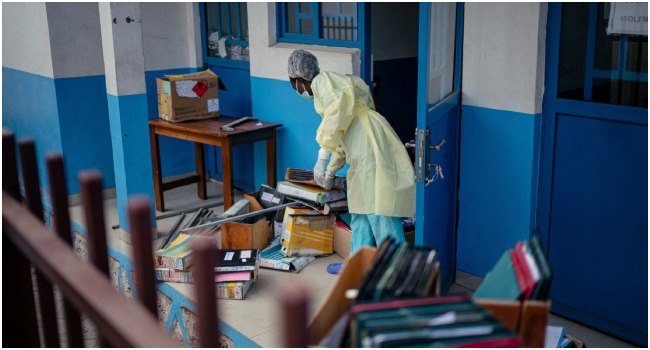
Health workers at an Ebola treatment centre in Mongbwalu, in the Democratic Republic of Congo, celebrated after the facility’s final patient recovered and left the centre.
The moment, reported by The Star on 29 October 2026, was marked by songs and dancing among healthcare workers associated with the Doctors Without Borders organisation, also known as Médecins Sans Frontières (MSF).
Footage described in the report showed a woman leaving the treatment area while medical staff celebrated her recovery. Some staff members remained in protective equipment on the treatment side of a partition, while others joined the celebration from the other side.
The discharge marked an important achievement for the medical teams involved in treating patients and responding to the outbreak.
Ebola outbreaks place considerable pressure on healthcare workers, who must provide treatment while following infection-prevention procedures designed to protect patients, staff and the surrounding community.
The recovery of the final patient at one facility is therefore a meaningful milestone. It reflects the work involved in clinical care, monitoring and maintaining safety procedures in a challenging environment.
Understanding the outbreak
The report said the outbreak was identified in the Democratic Republic of Congo in 2026 and involved the Bundibugyo virus, a species of Ebola virus.
The Congolese Ministry of Public Health declared the outbreak on 15 May 2026 after health authorities investigated clusters of severe illness and deaths in the Mongbwalu and Rwampara health zones in Ituri Province.
The outbreak created significant public health challenges, including the need to identify cases, provide treatment, trace contacts and maintain surveillance in affected communities.
The situation was complicated by population movement, insecurity and difficulties reaching some areas. Such conditions can make it harder for health authorities to detect infections quickly and ensure that patients receive timely care.
According to the report, transmission had expanded to several health zones and provinces by August, based on information from the World Health Organization. The scale of that spread highlights why a single treatment centre’s progress should not be interpreted as evidence that all transmission has stopped.
Why the last patient’s recovery matters
Discharging the last patient at a treatment centre can help reduce the immediate workload on that facility and provide a moment of encouragement for staff and affected communities.
It can also signal that patients receiving care at that centre have completed their treatment and recovery process.
However, Ebola response efforts do not end when the last patient leaves a particular facility. Health authorities must continue monitoring people who may have been exposed, investigating suspected cases and checking for signs of further transmission.
The wider outbreak can only be considered over when the relevant public health authorities apply the required criteria and complete the appropriate monitoring period without new cases.
The distinction is important because people may have been infected before the final patient was discharged, and additional cases can be identified through surveillance. The recovery of one group of patients does not automatically rule out infections elsewhere.
Treatment and prevention challenges
Ebola is a serious infectious disease that can cause severe illness and death. Different Ebola viruses have different characteristics, and medical countermeasures available for one type may not necessarily be effective against another.
The Star report identified the outbreak virus as Bundibugyo virus and noted the absence of a licensed vaccine or specific treatment for that strain. Clinical care and supportive treatment remain important, and early medical attention can improve a patient’s chances of survival.
Public health measures include identifying suspected cases, isolating patients when appropriate, tracing contacts and communicating clear information to communities.
Healthcare workers also require protective equipment and training to reduce the risk of infection while caring for patients. Communities need access to accurate information so that people can seek care promptly and cooperate with health teams.
What happens next?
The recovery celebrated in Mongbwalu is encouraging, but the wider public health response remains essential.
Authorities and health organisations must continue surveillance and follow the official criteria used to determine when the outbreak has ended. Monitoring also helps health teams respond quickly if further suspected cases emerge.
The episode demonstrates the importance of sustained investment in local healthcare capacity, laboratory testing, infection prevention and emergency preparedness.
For the medical staff who witnessed the patient’s departure, the celebration was a moment of relief after demanding work. For the wider community, it is a hopeful development that must be followed by continued vigilance.
The central message is that patient recovery is an important step in controlling an outbreak, but it is not the same as a formal declaration that transmission has ended.