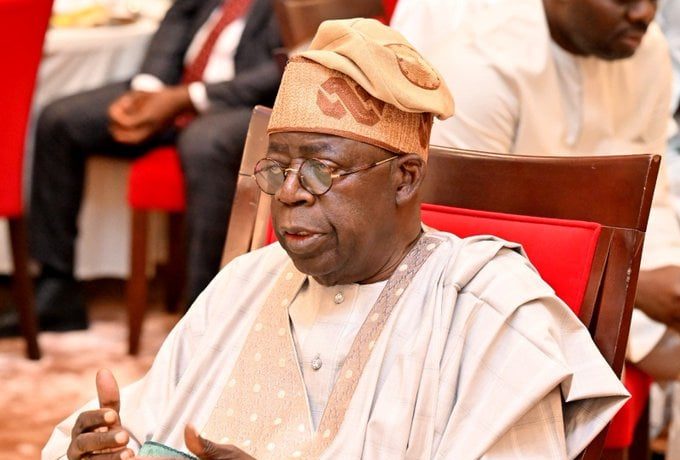
President Bola Tinubu has called on African countries to strengthen their local defence industries, improve military cooperation and prioritise technology transfer as part of efforts to address the continent’s growing security challenges.
The President said the acquisition of military equipment alone would not guarantee lasting security unless African countries developed the technical knowledge, industrial capacity and expertise required to maintain their defence systems.
Tinubu made the position known during the opening ceremony of the Africa International Defence Exhibition 2026 in Lagos on October 26.
He was represented at the event by the President of the Senate, Godswill Akpabio.
According to a report published by Punch Newspapers on October 27, Tinubu urged African governments to ensure that defence agreements produced lasting benefits for their countries rather than simply providing access to foreign military equipment.
The President explained that successful defence partnerships should help African engineers acquire new skills, encourage the growth of local enterprises and strengthen institutions responsible for national security.
He argued that African countries must develop the capacity to operate, maintain and improve the equipment they purchase from international partners.
Technology transfer and local industrial development
Tinubu stressed that technology transfer should form an important part of military procurement and international defence cooperation.
He said African countries should measure the success of their defence partnerships by the capabilities they leave behind.
According to him, the development of local expertise would help African governments reduce excessive dependence on foreign suppliers while strengthening their ability to respond to emerging security threats.
The President also encouraged greater investment in research, innovation and technical education.
He noted that African countries needed to create opportunities for young people with the skills and talent to contribute to the development of modern defence technologies.
The call reflects a broader challenge facing many African governments, which continue to depend on foreign manufacturers for military equipment, maintenance services and specialised technology.
Building local defence industries could provide opportunities for engineering companies, technology firms, research institutions and skilled workers.
However, such development would require long-term investment, effective policies, access to technical knowledge and cooperation between governments and the private sector.
Growing security threats across Africa
Tinubu also highlighted the increasingly interconnected nature of security challenges confronting African countries.
He identified terrorism, insurgency, banditry, piracy, cyber threats and emerging technologies as issues requiring stronger cooperation among governments.
The President warned that insecurity continued to affect lives, livelihoods, trade and economic development across the continent.
He specifically called for stronger cooperation in protecting the Gulf of Guinea, which plays an important role in international trade and energy transportation.
Maritime insecurity in the region can affect shipping activities, commercial operations and the movement of goods.
The Gulf of Guinea is particularly important to West African economies because it supports international shipping routes and access to offshore energy resources.
Tinubu maintained that African countries must work together to protect legitimate commercial activities while preventing criminal networks from operating freely.
Investment in emerging technologies
The President further called for increased investment in cybersecurity, space technology, artificial intelligence and autonomous systems.
He noted that modern security operations increasingly depend on technological capabilities and that African countries must develop the knowledge required to understand and responsibly deploy such technologies.
The Africa International Defence Exhibition was therefore presented as an opportunity to encourage cooperation, exchange knowledge and establish partnerships capable of strengthening the continent’s defence capabilities.
Tinubu urged participants to ensure that agreements reached during the exhibition translated into practical results.
The President’s position places emphasis on the relationship between security and economic development.
A stronger defence industry could support industrialisation, create skilled employment and encourage technological innovation.
Nevertheless, the success of such ambitions will depend on the ability of African governments to turn policy commitments into sustainable investments and measurable improvements.
For Nigeria and other African countries, the challenge is not simply to acquire more military equipment but to develop the local expertise and institutions required to support long-term security.