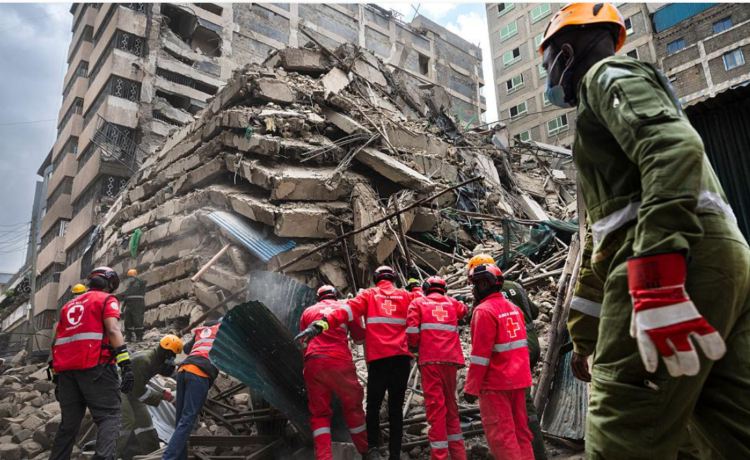
Rescue operations have continued in Nairobi after an 18-storey building collapsed on a busy commercial street on Friday, October 23, leaving dozens of people reported missing and raising renewed concerns about construction safety and regulatory enforcement.
According to the Associated Press, four people had been rescued alive by the third day of operations on Sunday. Among the survivors were a tailor, Victor Onyango, and a shop owner, Zaynaba Mohammed. Both received hospital treatment and were subsequently discharged.
Rescuers continued searching through concrete and twisted steel as families waited for information about relatives who might have been trapped inside the building.
The Kenya Red Cross had reported 47 people missing by Sunday, although the number of people unaccounted for remained subject to verification as emergency teams gathered information.
Rescue teams face difficult conditions
Building collapses create dangerous working conditions for emergency responders. Unstable walls, heavy concrete slabs and damaged structural components can make it difficult to reach people trapped beneath the debris.
Rescue teams must work carefully to avoid causing further collapses while locating possible survivors. Heavy machinery can help remove rubble, but it must be used cautiously where people may still be alive underneath.
The passage of time increases the urgency of the operation, but the condition of each trapped person can vary considerably. Authorities must rely on direct assessments rather than assumptions about survival.
Families gathered near the site hoping for news. For many, the uncertainty has been compounded by the difficulty of obtaining verified information about those who may have been inside when the building fell.
The incident has therefore become both an emergency rescue operation and a test of the city’s ability to coordinate public information and support affected families.
Questions over approvals
The collapse has also raised questions about compliance with construction regulations.
Authorities said the building lacked the required construction approval and an occupancy certificate. The absence of these documents has increased scrutiny of how building projects are authorised and inspected in Nairobi.
An occupancy certificate is intended to confirm that a building meets relevant requirements before it is used. Where a building is occupied without the necessary approvals, officials must establish who was responsible and whether enforcement failures contributed to the danger.
Nairobi County Governor Johnson Sakaja called for stronger enforcement of building regulations and criticised fines that he said were insufficient to deter unsafe development.
However, the precise cause of the collapse had not been established in the reports available on October 26. A technical investigation will be needed to determine whether structural defects, construction practices, alterations, material quality or other factors played a role.
The need for stronger oversight
Rapid urban growth can put pressure on housing, commercial space, infrastructure and municipal inspection services. But construction speed and demand cannot replace structural safety requirements.
Effective oversight requires qualified professionals, approved designs, inspections at appropriate stages and action against buildings that do not comply with safety standards.
Authorities must also investigate whether enforcement officers had previously inspected the property and whether any warnings or complaints were recorded.
Where violations are established, accountability should follow the evidence and the law. The investigation should be transparent enough to help prevent similar incidents elsewhere.
Supporting affected families
The emergency response also involves identifying victims, confirming missing-person reports and communicating with relatives.
Authorities need accurate records to avoid duplicate reports and to help families understand the status of searches. Survivors may require medical care, psychological support and assistance with accommodation or lost belongings.
Businesses operating in the affected area may also face disruption, particularly if surrounding streets remain restricted while rescue and inspection work continues.
Lessons for Nairobi
The collapse is a stark reminder that building regulation is a public safety responsibility. Construction permits and inspections are intended to protect occupants, workers and people passing nearby.
As rescue operations continue, the immediate priority is to locate missing people and provide support to those affected. The longer-term responsibility is to establish what caused the collapse and ensure that any failures in design, construction or regulation are addressed.
A credible investigation, consistent enforcement and improved public access to safety information will be essential to restoring confidence and preventing similar tragedies.