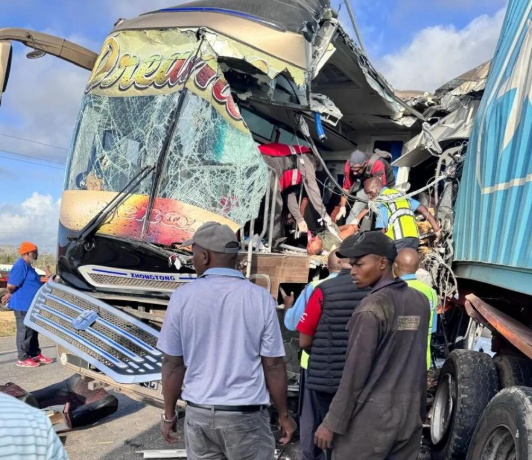
At least 24 people have been killed and another 24 injured after a bus collided with a truck on Kenya’s Nairobi–Mombasa highway on Sunday, October 25, in an accident that has renewed concerns about road safety and the enforcement of transport regulations.
The bus was carrying members of a church congregation returning to Mombasa after attending their pastor’s funeral in western Kenya. The collision occurred in the Kanga area near Mtito Andei in Makueni County, along one of the country’s major transport routes.
According to the Associated Press, the injured passengers were taken to Mtito Andei hospital for treatment. Authorities began investigating the circumstances surrounding the crash, while President William Ruto expressed condolences to the victims’ families and called for stronger safety checks on public service vehicles.
The accident has again drawn attention to the dangers faced by passengers using long-distance buses and trucks on busy highways.
Questions about the cause
Initial accounts of the collision differed. A survivor said a truck struck the bus from behind, causing it to overturn. Kenya’s National Transport and Safety Authority initially indicated that improper overtaking may have contributed, based on information suggesting a head-on collision.
Investigators will need to establish the precise sequence of events before a definitive cause can be confirmed.
The findings may help determine whether driver behaviour, vehicle condition, road design, visibility or other factors contributed to the crash.
Until the investigation is completed, it would be premature to assign responsibility to a particular driver or company.
A recurring road safety problem
The latest tragedy comes only weeks after another fatal crash on the same highway killed 17 people. The repetition of serious accidents along the Nairobi–Mombasa route has increased pressure on authorities to improve road safety.
The highway carries passenger buses, private cars and heavy commercial vehicles transporting goods between Nairobi and the country’s coastal region. Its importance to domestic travel and commerce means that accidents can have consequences beyond the immediate loss of life.
Road crashes can place considerable pressure on hospitals, disrupt transport services and leave families facing unexpected funeral expenses and loss of income.
Kenya’s transport safety authority has described road accidents as a national emergency. Reports cited by the Associated Press indicate that the country records approximately 20,000 crashes and more than 5,000 deaths annually.
These figures underline the need for sustained enforcement rather than temporary inspections following high-profile accidents.
Government response
President Ruto has ordered inspections of public service vehicles to check compliance with safety requirements. Such inspections can help identify defective vehicles and ensure that operators meet applicable standards.
However, enforcement needs to extend beyond vehicle checks. Authorities must also examine driver working hours, speeding, dangerous overtaking, passenger limits, tyre conditions and the availability of functioning safety equipment.
Transport companies have a responsibility to maintain their fleets and ensure that drivers are fit to operate vehicles safely. Drivers must obey traffic rules, while passengers should use available safety belts and avoid travelling in overloaded vehicles.
The wider economic impact
Road transport remains central to Kenya’s economy. It connects major cities, supports tourism and enables the movement of agricultural products and manufactured goods.
Frequent fatal accidents undermine public confidence and impose costs on families, businesses and the public health system. Improving safety can therefore protect both human lives and economic activity.
The investigation into Sunday’s crash should provide a clearer account of what happened and whether specific safety failures contributed to the collision.
For now, the incident serves as a reminder that road safety requires consistent action from regulators, transport operators and motorists. Promises made after major accidents must translate into effective inspections, fair enforcement and safer travel conditions.