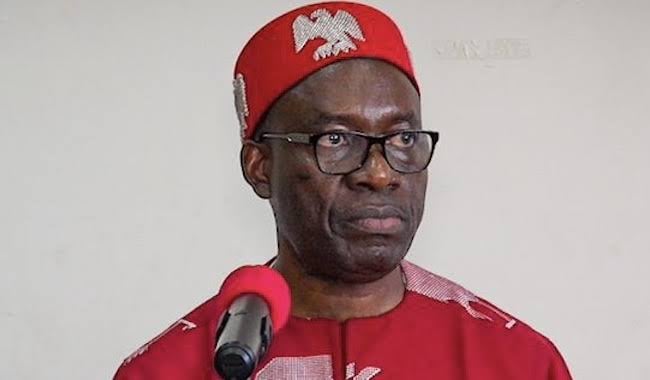
Anambra State Governor, Professor Charles Soludo, has explained that his administration withdrew the state from a World Bank-backed loan programme because prevailing exchange rate conditions made the facility financially unattractive despite its low interest rate.
Soludo disclosed this on Monday, August 3, 2026, while speaking at the Delta State Economic and Investment Summit, where he said macroeconomic realities at the time influenced the decision to exit the World Bank-supported NG-CARES programme.
The governor said exchange rate distortions meant that even a zero-interest loan could become extremely expensive when converted into local currency obligations.
According to Soludo, Anambra was the only state to withdraw from the programme after his administration assessed the potential impact of currency depreciation on repayment costs.
“When I became governor, I pulled Anambra State out of an ongoing World Bank loan, NG-CARES, and Anambra was the only state that pulled out,” he said.
He added that the foreign exchange situation at the time made the loan costly, despite the absence of interest charges.
“Because the macro fundamentals, the foreign exchange, the exchange rate distortions were such that I told the World Bank that even at zero interest, it was still the most expensive fund in the world,” Soludo stated.
The governor explained that borrowing in dollars during a period of exchange rate uncertainty could create a significant financial burden for states.
“If you are giving me money and I change it at 460 naira to the dollar today, when I know that tomorrow it will be over 1,000, even if you lend it to me at zero, the effective interest rate in it is over 100 percent,” he said.
Soludo maintained that exchange rate stability remains critical for attracting foreign investment and supporting sustainable economic growth at both national and subnational levels.
The former Central Bank of Nigeria governor also reiterated his administration’s zero-borrowing policy, saying Anambra had not taken loans from commercial banks, the Federal Government or international financial institutions since he assumed office.
Although the Anambra State House of Assembly approved a N100bn borrowing facility in 2022, the governor’s administration did not utilise the approval.
The state government also denied reports in August 2024 that it planned to obtain a N245bn to N247bn loan to finance budget deficits, describing the claims as inaccurate.
Soludo said Nigeria’s macroeconomic outlook had improved, noting that net foreign exchange reserves increased from about $3bn in 2023 to more than $40bn, while gross reserves rose to approximately $52bn.
He said improved exchange rate stability and stronger economic fundamentals would help Nigeria attract more foreign capital.
The governor, who has previously expressed support for President Bola Tinubu’s economic reforms, said structural changes were necessary to stabilise the economy and place Nigeria on a sustainable growth path.
He stressed that prudent fiscal management, responsible borrowing and macroeconomic stability remain essential for long-term economic development.