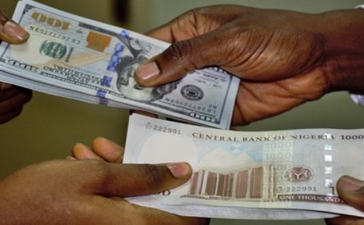
The naira strengthened at Nigeria’s official foreign exchange market in August, supported by improved dollar liquidity and foreign exchange inflows, but moved in the opposite direction at the parallel market, widening the gap between both segments.
At the Nigerian Foreign Exchange Market, NFEM, the currency appreciated by 2.58 per cent month-on-month to close August at N1,332.94 to the dollar, compared with N1,368.22/$ in July.
The naira had traded at N1,379.68/$ at the end of June, translating to an appreciation of about 3.39 per cent over the two-month period.
However, conditions were different in the parallel market, where the dollar averaged N1,405 at the end of August, compared with N1,388 in July.
The development widened the gap between the official and parallel exchange rates to N72.06 per dollar, representing a premium of about 5.4 per cent.
That marked a significant increase from July, when the spread stood at N19.78, equivalent to 1.45 per cent.
In June, the difference between the two markets was even narrower at N10.32, or about 0.75 per cent.
Dollar Demand Remains Strong
Analysts said the widening premium indicates that demand for foreign currency outside the formal market remains elevated despite improved liquidity at NFEM.
Seasonal demand associated with international travel, commercial transactions and other dollar requirements was identified as one of the factors contributing to pressure in the parallel market.
The divergence also suggests that the improvement in official foreign exchange supply is yet to transmit evenly across all segments of the currency market.
Portfolio inflows and stronger non-oil foreign exchange receipts have helped improve liquidity at the official window.
Single-session NFEM turnover exceeded $1.06 billion during the period, pointing to improved trading activity and availability of foreign currency.
External Reserves Provide Support
Nigeria’s growing external reserves are providing another layer of support for the naira.
Gross external reserves increased to $53.51 billion as of August 28, representing a 3.06 per cent increase from $51.92 billion at the end of July.
Compared with $51.46 billion at the end of June, reserves had risen by about 3.98 per cent.
The reserve position was also above the Central Bank of Nigeria’s $51.04 billion full-year target and was estimated to provide about 10.5 months of import cover.
Improving reserves give the CBN a stronger buffer against external shocks and provide additional confidence in the country’s ability to meet international obligations.
Oil Prices Pose Risk
Despite the stronger reserve position, declining crude oil prices remain a potential risk to the foreign exchange outlook.
Brent crude fell 7.46 per cent month-on-month to $83.40 per barrel during August, while Nigeria’s Bonny Light declined 6.64 per cent to $88.50 per barrel.
Bonny Light remained above the Federal Government’s 2026 budget benchmark of $75 per barrel, but a sustained decline in international oil prices could weaken export earnings and reduce dollar inflows.
Analysts at Cowry Research said stronger reserves, improved liquidity and sustained FX inflows remained supportive of the naira at the official window.
However, they warned that the widening parallel-market premium and weaker crude prices would require monitoring as seasonal foreign exchange demand evolves.
The contrasting movements mean that while Nigeria has recorded progress in stabilising the official FX market, pressure outside the formal window remains a challenge for policymakers seeking greater convergence between exchange rates.