Iran has rejected claims by United States Vice-President JD Vance that it agreed to allow international nuclear inspectors back into the country, casting uncertainty over efforts to secure a final agreement following the first round of renewed talks between Washington and Tehran.
The development came after negotiations in the Swiss resort town of Bürgenstock, where both sides discussed measures aimed at ending tensions and establishing a framework for a broader agreement.
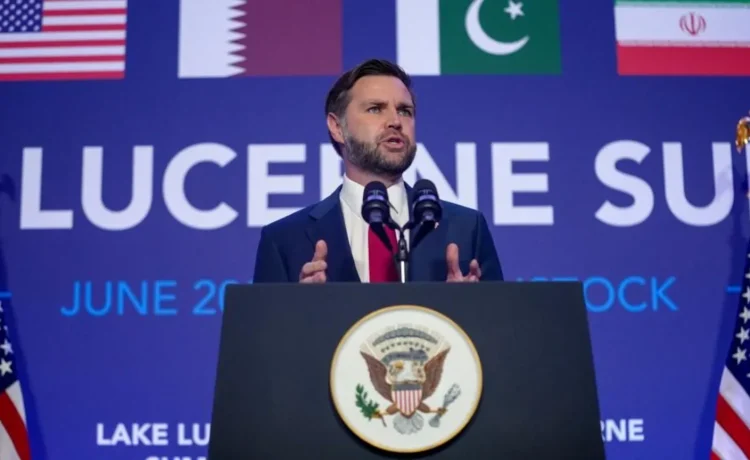
Speaking after the talks, Vance said discussions involving the International Atomic Energy Agency (IAEA) could begin “as soon as today,” suggesting that progress had been made on restoring access for nuclear inspectors.
However, Iran’s Foreign Ministry swiftly rejected the claim.
According to Iranian state media, Foreign Ministry spokesman Esmail Baqai said Tehran had made “no new commitments” regarding nuclear inspections.
Baqai insisted that any future engagement with the IAEA would occur strictly under existing procedures approved by Iran’s Parliament and Supreme National Security Council.
The disagreement emerged as the United States temporarily eased sanctions on Iran, allowing the country to sell oil in US dollars for the first time in decades.
In a joint statement released by mediators Qatar and Pakistan, officials said both countries had agreed on a roadmap aimed at reaching a final deal within 60 days.
Vance described the discussions as productive and said they had established a “very good foundation” for future negotiations.
According to the US vice-president, the talks covered several critical issues, including the reopening of the Strait of Hormuz and mechanisms to support regional de-escalation efforts.
The 60-day sanctions waiver issued by the US Treasury represents one of the most significant temporary relaxations of restrictions imposed on Iran in recent years.
The measure authorises the production, sale and delivery of Iranian crude oil and petrochemical products until August 21, 2026.
Under the waiver, Iranian oil can also be imported directly into the United States, while restrictions on banking transactions, insurance and transportation related to oil exports have been eased.
US Treasury Secretary Scott Bessent said the sanctions relief was granted in exchange for commitments by Tehran to keep the Strait of Hormuz open and permit the return of IAEA inspectors.
When asked about the timeline for inspections, Vance said he expected the process to begin at least within the week, adding that discussions with inspectors could start immediately.
US President Donald Trump also expressed confidence that Iran would eventually agree to major weapons inspections.
Despite those statements, Iranian officials maintained that no additional commitments had been made beyond existing legal frameworks.
The IAEA has yet to issue an official response.
Iran suspended access to sites damaged during Israeli and US military strikes in last year’s 12-day conflict. A month later, the United Nations nuclear watchdog announced the withdrawal of its remaining inspectors from the country.
The dispute over inspections comes against the backdrop of the 2015 nuclear agreement reached between Iran and six world powers, including the United States, China, France, Russia, Germany and the United Kingdom.
That agreement allowed extensive monitoring of Iran’s nuclear programme by the IAEA.
However, during his first term in office, Trump withdrew the United States from the deal in 2018, arguing that it failed to adequately address concerns about Iran’s nuclear activities.
Vance revealed that Iranian negotiators had threatened to leave the talks after Trump warned that the United States could respond forcefully if Tehran failed to comply with future agreements.
According to the vice-president, he reassured Iranian officials that Trump’s comments were a response to provocative rhetoric rather than an indication that negotiations were collapsing.
Speaking from the Oval Office on Monday, Trump reiterated his warning.
“If Iran doesn’t live up to their agreement, or if they’re not behaving, I will do what I have to do,” the US president said.
Iranian media reported that the country’s lead negotiators departed Switzerland after the conclusion of the talks.
However, technical discussions are expected to continue through specialised negotiating groups focusing on nuclear issues, sanctions relief and reconstruction efforts.
The joint statement issued by Qatar and Pakistan also announced the creation of a dedicated communication channel aimed at preventing incidents and ensuring the safe passage of commercial vessels through the Strait of Hormuz.
In addition, the parties agreed to establish a de-confliction mechanism involving the United States, Iran and Lebanon to help end military operations in Lebanon.
Iranian Foreign Minister Seyed Abbas Araghchi described Lebanon as the first major test of the emerging diplomatic framework.
Recent reports indicate that fighting between Israel and Hezbollah has eased, with a fragile ceasefire largely holding since the weekend.
The outcome of the next phase of negotiations is expected to determine whether the current diplomatic momentum can be translated into a broader agreement capable of reducing regional tensions and addressing long-standing concerns over Iran’s nuclear programme.