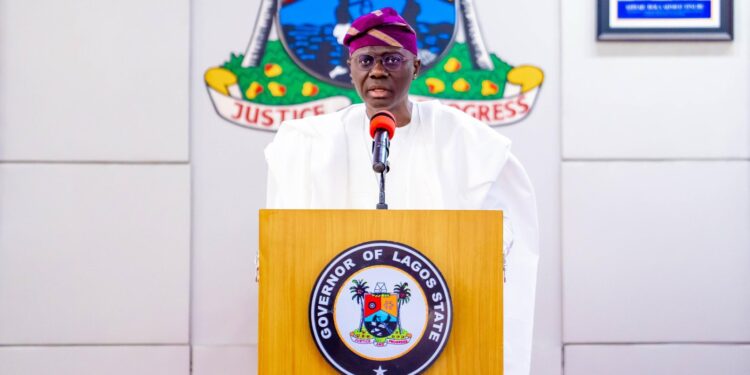
Lagos State Governor Babajide Sanwo-Olu has unveiled Sanwo-Olu: Against All Odds, a photographic chronicle documenting defining moments of his administration and the transformation of Lagos during his first and second terms.
The book was unveiled at the grand ballroom of Eko Hotels and Suites in Victoria Island, Lagos, at an event that brought together political leaders, traditional rulers, business executives, diplomats and prominent figures from across Nigeria.
The occasion featured the presence of white-cap chiefs and Lagos monarchs dressed in flowing white regalia, adding a strong traditional dimension to the event and highlighting the connection between Lagos’ heritage and its modern development.
Among those who attended were Senate President Godswill Akpabio, represented by Deputy Senate President Barau Jibrin; Imo State Governor Hope Uzodinma; Borno State Governor Babagana Zulum; Deputy Speaker of the House of Representatives Benjamin Kalu; Lagos State Deputy Governor Obafemi Hamzat and Speaker of the Lagos State House of Assembly Mudashiru Obasa.
Speaking at the unveiling, Sanwo-Olu said the publication was not simply a record of his administration but a story about Lagos and the resilience of its people.
“Books about leaders are usually written when the story has ended. This one is different,” the governor said.
He explained that the real focus of the book was the people who continued to keep Lagos moving through periods of uncertainty and crisis.
“The true subject is Lagos itself—the market woman rebuilding her store, the nurse who had not seen her family for weeks during the pandemic, the young person demanding to be heard, the engineer on a bridge project, the school child walking into a classroom that did not exist a year before,” he said.
Authored by Sanwo-Olu’s official photographer, Ademola Olaniran, Against All Odds documents some of the most significant moments in Lagos’ recent history.
The book captures the COVID-19 pandemic, the EndSARS protests, the Abule-Ado explosion and tragic building collapses, alongside the government’s response to the challenges faced by residents.
It also highlights major infrastructure and development projects, including the Blue and Red Rail Lines and the Lekki Deep Sea Port, as well as investments in housing, healthcare, education and food security.
Representing Senate President Godswill Akpabio, Deputy Senate President Barau Jibrin described the publication as more than a collection of photographs, saying it provides a visual record of governance during some of the most challenging periods in Lagos’ history.
He said the photographs preserved not only major projects but also the human experiences behind them, including courage, sacrifice and hope.
“This book is more than photographs; it is a testimony of governance under pressure, of decisions taken at critical times, and of a city that continues to rise above challenges,” Barau said.
He added that future generations would find in the publication a record of how Lagos navigated a demanding period while continuing to pursue development.
Lagos Deputy Governor Obafemi Hamzat also described photography as an important tool for preserving history.
“History is not only written in words; it is also captured through the lens. This work reminds us that leadership is not merely about policies and projects but about the people whose lives are touched by those decisions,” Hamzat said.
Guests also viewed an exhibition featuring photographs from the book.
The images captured healthcare workers during the COVID-19 pandemic, young Nigerians participating in the EndSARS protests, engineers working on major infrastructure projects and communities recovering from tragic incidents.
One of the photographs that attracted particular attention showed four Lagos governors jointly holding a model train, symbolising the continuity of development across successive administrations.
Reflecting on the state’s journey, Sanwo-Olu said Lagos had continued to make progress despite experiencing multiple crises.
“Trial upon trial, grief upon grief, yet Lagos never stopped building. Lagos never stopped moving forward,” he said.
The governor paid tribute to President Bola Ahmed Tinubu and former governors Babatunde Raji Fashola and Akinwunmi Ambode, describing them as architects of modern Lagos.
He said sustainable development required successive administrations to build on the achievements of their predecessors rather than dismantling them.
“In this state, we do not tear down what our predecessors built; we build upon it. I inherited dreams, and I have laboured to hand over the foundations,” Sanwo-Olu said.
Olaniran, whose photographs form the core of the publication, said the book was intended to preserve an important part of Lagos’ shared history.
“Some leaders are blessed with great stories, while others find great storytellers. This is a great story, and I believe it deserves to be preserved,” he said.
The presence of Lagos’ traditional rulers also added significance to the event, reflecting the enduring relationship between the state’s cultural heritage and its modern governance structure.
As images from the book were displayed across large screens at the venue, the event highlighted the human stories behind Lagos’ development, from families rebuilding after tragedy to healthcare workers serving during a pandemic and young people pursuing opportunities in a rapidly changing city.
The unveiling brought together government officials, traditional institutions, business leaders, development partners and other stakeholders to reflect on Lagos’ journey and its future.
By the end of the ceremony, Sanwo-Olu: Against All Odds had emerged not only as a photographic record of the governor’s tenure but also as a visual portrait of a city that has endured crises, embraced change and continued to pursue growth.