Egypt is marking 104 years since the discovery of the tomb of ancient Egyptian pharaoh Tutankhamun, one of the most important archaeological discoveries in modern history.
The tomb was discovered by British archaeologist Howard Carter on November 4, 1922, in the Valley of the Kings near Luxor. The discovery attracted worldwide attention because the burial chamber contained an extraordinary collection of ancient treasures that had survived largely intact for more than 3,000 years.
The anniversary highlights the importance of the discovery to Egypt’s cultural heritage, international archaeology and tourism industry.
Carter had spent years searching the Valley of the Kings for the young pharaoh’s burial place. His efforts finally paid off when workers uncovered the first step of a staircase leading underground on November 4, 1922.
By the following day, the team had uncovered a sealed doorway. Carter then contacted his financial supporter, Lord Carnarvon, to inform him of the discovery.
The tomb was formally entered by Carter and Carnarvon on November 26, 1922, when they opened a small section of the sealed entrance and looked inside.
The discovery became an international sensation, with newspapers and historians closely following the excavation.
Tutankhamun Spatial Archive+2
More Than 5,000 Ancient Treasures Found
Tutankhamun’s tomb, officially identified as KV62, contained more than 5,000 objects, making it one of the richest archaeological discoveries ever recorded.
Unlike many other royal burial sites in the Valley of the Kings, which had been extensively looted over the centuries, Tutankhamun’s tomb was found relatively intact.
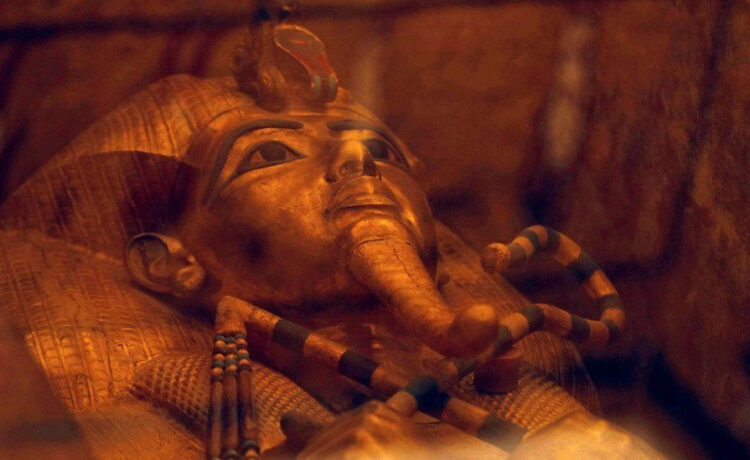
Among the most remarkable discoveries were the pharaoh’s famous golden funerary mask, elaborate jewellery, ceremonial objects, furniture, chariots and weapons.
The burial also contained three nested coffins placed inside a stone sarcophagus. The innermost coffin was made of solid gold, while the other coffins were decorated with precious materials.
The treasures provided researchers with valuable information about ancient Egyptian craftsmanship, religious beliefs, royal life and burial traditions.
The excavation was not completed quickly. Carter and his team spent approximately 10 years carefully documenting, preserving and removing the objects from the tomb.
The University of Oxford’s Griffith Institute preserves a major collection of records from the excavation, including photographs, diaries, drawings, maps and descriptions of the objects.
These records continue to support archaeological research and help historians understand the significance of the discovery.
Oxford University+2
Who Was King Tutankhamun?
Tutankhamun was an Egyptian pharaoh of the 18th Dynasty who ruled during the New Kingdom period, approximately between 1336 and 1327 BC.
He became king at a very young age, believed to be around eight or nine years old, and ruled for approximately nine years before dying as a teenager.
Although his reign was relatively short, he became one of the most recognised figures in ancient Egyptian history because of the extraordinary condition of his tomb and the treasures discovered inside it.
During his rule, Tutankhamun helped restore traditional religious practices following the religious changes introduced under his predecessor, Akhenaten.
His death at a young age has remained a subject of scientific investigation for decades.
Researchers have examined his mummy using X-rays, computerised tomography scans and DNA analysis to understand his health and possible cause of death.
A 2010 study published in the Journal of the American Medical Association identified evidence of several health problems, including a bone disorder and malaria infection.
The researchers suggested that complications involving bone damage and malaria may have contributed to his death. However, the precise circumstances surrounding his death remain a subject of historical and scientific discussion.
PubMed+2
Grand Egyptian Museum Preserves Tutankhamun’s Legacy
Tutankhamun’s treasures remain among Egypt’s most important cultural attractions.
The collection has gained renewed international attention following the full public opening of the Grand Egyptian Museum in November 2025.
Located near the Giza pyramids, the museum houses more than 100,000 artefacts from different periods of ancient Egyptian civilisation.
One of its major attractions is the complete Tutankhamun collection, which brings together thousands of objects recovered from the pharaoh’s tomb.
The museum provides visitors with an opportunity to explore the treasures and learn more about the young king, his family, his reign and ancient Egyptian burial practices.
The opening has also strengthened Egypt’s efforts to promote its archaeological heritage as an important part of its tourism industry.
SIS+2
Archaeological Heritage Remains Important to Egypt’s Tourism
Egypt’s ancient monuments, temples, museums and archaeological sites continue to attract visitors from different parts of the world.
The discovery of Tutankhamun’s tomb remains one of the country’s strongest international cultural attractions because of its historical importance and the remarkable objects recovered from the burial site.
The Valley of the Kings, where the tomb is located, is also an important destination for visitors interested in ancient Egyptian history.
The Egyptian Ministry of Tourism and Antiquities continues to preserve the tomb and other historic monuments while promoting archaeological tourism.
The anniversary also provides an opportunity to recognise the contributions of Egyptian workers and specialists who participated in the excavation, conservation and documentation of the discovery.
Although Howard Carter is widely associated with the find, the excavation involved a much larger team whose work helped recover and preserve the treasures.
More than a century later, the discovery continues to influence archaeological research and attract global interest.
As Egypt marks 104 years since the historic find, Tutankhamun’s tomb remains a powerful reminder of the country’s ancient civilisation and the importance of protecting its cultural heritage for future generations.