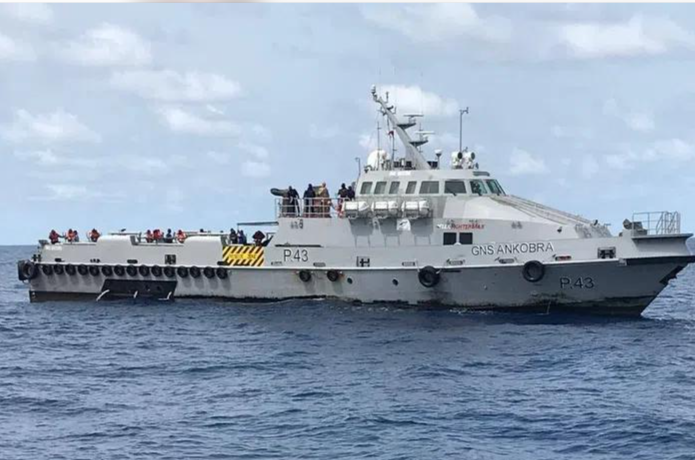
Seven Ghanaian fishermen who went missing during a fishing expedition have been rescued following a coordinated maritime search-and-rescue operation involving Ghana, Togo and Benin.
The fishermen were located in Beninese waters after their fishing canoe, identified as Second Chance, suffered an outboard motor failure and drifted away from its intended route. Their safe return to Ghana followed cooperation between naval forces, maritime authorities and local fishing communities.
According to information released by the Ghana Maritime Authority and Ghana’s maritime authorities on October 22, 2026, the fishermen had departed Sekondi for a fishing expedition towards Axim in Ghana’s Western Region.
The incident demonstrated how quickly an ordinary fishing trip can become a serious emergency when a vessel loses propulsion far from shore.
It also highlighted the importance of communication, vessel tracking and cooperation between neighbouring countries when maritime emergencies cross national boundaries.
Engine Failure Triggered the Emergency
The fishermen’s canoe became stranded after its outboard motor failed, leaving the crew vulnerable to winds and ocean currents.
The vessel subsequently drifted eastward into waters off the coast of Benin. The crew’s inability to control the canoe made it difficult for them to return safely to Ghana.
The fishermen had been missing for several days before a search-and-rescue effort was intensified. Their disappearance prompted coordination among Ghanaian maritime and security agencies, while information about their possible location was shared with neighbouring countries.
A distress alert on October 21 helped advance the search. The operation involved the Ghana Maritime Authority, the Ghana Navy, the Togolese Navy, the Beninese Navy and regional maritime coordination centres.
The Ghana Air Force and other Ghanaian agencies also contributed to the wider search effort, according to reports from the Ghana Navy and the Ministry of Fisheries and Aquaculture.
Regional Naval Cooperation Led to the Rescue
The Togolese Navy deployed its patrol vessel, OTI, which helped locate the distressed fishing canoe approximately three nautical miles off Grand-Popo in Beninese waters.
The Beninese Navy and a local Beninese fishermen’s association also played important roles in locating and rescuing the crew.
After the fishermen were found, arrangements were made to transfer them through the relevant maritime authorities and return them to Ghana.
Reports from the Ghana Navy and Ghana Maritime Authority state that the rescued fishermen were transferred through the Togolese Navy to the Ghana Navy near the Ghana-Togo maritime boundary.
The Ghana Navy vessel GNS AFLAO subsequently transported the fishermen and their recovered canoe towards Tema Fishing Harbour.
The successful operation showed the practical value of information-sharing between countries whose maritime zones are connected by busy fishing grounds and regional sea routes.
It also demonstrated that local fishing communities can support official search-and-rescue efforts when they are able to communicate with maritime authorities.
Safety Concerns for Artisanal Fishermen
The incident has renewed attention on safety challenges facing artisanal fishermen in the Gulf of Guinea.
Many small fishing canoes depend on outboard motors and may operate without the advanced navigation, tracking and distress-signalling systems commonly available on larger commercial vessels.
When an engine fails, a canoe may be carried away by currents and winds. Without reliable communication equipment or a functioning tracking device, locating the vessel can become more difficult as time passes.
The Ghanaian authorities have emphasised the importance of life jackets, reliable communication equipment, checking weather conditions before departure and observing maritime safety guidance.
The rescue has also strengthened calls for better vessel-tracking arrangements and improved safety equipment for small fishing boats.
Ghana’s Ministry of Fisheries and Aquaculture has highlighted the importance of modern tracking technology and stronger cooperation among fishing communities, maritime regulators and security agencies.
Such measures could help authorities identify the location of a missing vessel earlier and coordinate assistance before an emergency becomes more serious.
Implications for Maritime Safety in West Africa
The rescue is significant beyond Ghana because fishing activities and maritime emergencies frequently extend across national boundaries.
A vessel that departs from one country’s coast may drift into the waters of another country after losing engine power or encountering difficult weather conditions. Effective responses therefore require communication and cooperation between the countries concerned.
The Gulf of Guinea is important for fishing, regional trade and commercial shipping. Strengthening maritime safety in the region benefits fishing communities and supports broader efforts to improve security and emergency response at sea.
The participation of Ghana, Togo and Benin illustrates how regional partnerships can help address emergencies that no single country may be able to resolve as quickly on its own.
The contribution of local Beninese fishermen also underlines the value of involving coastal communities in maritime safety networks.
A Call for Better Preparedness
The safe return of the seven fishermen brought relief to their families and communities, but the incident also provided important lessons about prevention.
Fishing operators can reduce some risks by checking their engines before departure, carrying appropriate safety equipment, maintaining reliable communication methods and informing others about their planned routes.
Authorities can complement these efforts by improving access to tracking devices, strengthening emergency communication systems and ensuring that search-and-rescue agencies can coordinate across borders.
The rescue of the Second Chance crew stands as an example of successful regional cooperation. It also reinforces the need for sustained investment in maritime safety so that fishermen can carry out their work with better protection against unexpected emergencies.