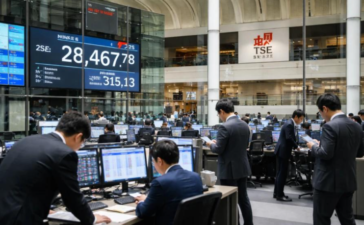
Asian stock markets fell on Tuesday as investors assessed geopolitical tensions, higher oil prices and upcoming corporate earnings from some of the world’s largest technology companies.
Reuters reported that the MSCI Asia ex-Japan index declined by 1.14%, while Japan’s Nikkei 225 dropped 0.98%. South Korea’s KOSPI suffered a sharper fall of 3.92%, reflecting pressure across the region’s equity markets.
The declines came as investors prepared for earnings announcements from major companies and reconsidered how much they were willing to pay for businesses linked to artificial intelligence.
The latest movement illustrates a changing focus in financial markets. Investors are still interested in AI, but they increasingly want evidence that the enormous sums being spent on computing infrastructure, chips and data centres will generate sufficient returns.
Why AI investment is under scrutiny
Artificial intelligence has become a major driver of investment in technology infrastructure.
Companies are building data centres, purchasing advanced processors and expanding the computing capacity needed to develop and operate AI systems. These investments can support new products, improve productivity and create opportunities for businesses supplying equipment and services.
However, the infrastructure is expensive. Data centres require land, electricity, cooling systems, networking equipment and large amounts of computing hardware.
Investors must therefore consider whether the revenue generated by AI services will justify these costs.
A company can report growing demand for its products while still facing pressure if its investment spending increases faster than its earnings. High borrowing costs can make the problem more serious because financing large projects becomes more expensive.
Reuters reported that investors were increasingly focused on whether AI-related capital expenditure would earn more than it costs to finance.
That question matters because expectations of rapid future growth have helped support valuations in parts of the technology sector.
Corporate earnings take centre stage
Investors were also preparing for results from companies including Netflix and SpaceX, with Meta and Tesla scheduled to report later in the week, according to Reuters.
Corporate earnings provide information about revenue, profits, operating costs and management expectations.
For technology companies, investors are particularly interested in how much AI-related spending is increasing and whether customers are paying enough for new services to make the investment worthwhile.
Results that exceed expectations can support share prices. Disappointing guidance or rising costs can have the opposite effect, particularly when investors have already priced in strong growth.
The response to earnings also depends on what analysts expected before the announcement. A company can report higher profits than a year earlier and still see its shares decline if the results fall short of market forecasts.
Geopolitical tensions add pressure
Financial markets were also responding to developments affecting energy supplies and international trade.
Reuters reported that oil prices rose as investors considered changes to US measures affecting Russian energy exports and the wider geopolitical environment.
Higher oil prices can increase the cost of transport, manufacturing and electricity in countries that rely heavily on imported energy.
If those costs feed into consumer prices, central banks may have less room to reduce interest rates. Higher rates can then weigh on borrowing, investment and household spending.
These effects are particularly important for economies that are already facing weak demand or pressure on public finances.
What the decline means for investors
A fall in a stock-market index does not necessarily mean an economy is entering a recession. Share prices respond to expectations, interest rates, corporate earnings and geopolitical developments, sometimes changing significantly within a single trading session.
However, sharp declines can reveal growing uncertainty about the value of investments or the risks companies face.
Investors may respond by reducing exposure to sectors they consider expensive, diversifying their portfolios or waiting for clearer information from company earnings.
For individual investors, the latest movement is a reminder that shares linked to a popular technology trend can still experience significant volatility.
The outlook
The direction of global markets will depend partly on whether upcoming earnings support expectations for continued growth.
Investors will also monitor oil prices, interest-rate expectations and geopolitical developments. Any substantial change in these factors could influence corporate costs and market sentiment.
Artificial intelligence remains an important area of technological development, but investment decisions will increasingly depend on financial performance as well as future potential.
The central question is no longer simply whether AI adoption will expand. It is whether companies can turn that adoption into sustainable profits without taking on excessive financial risk.