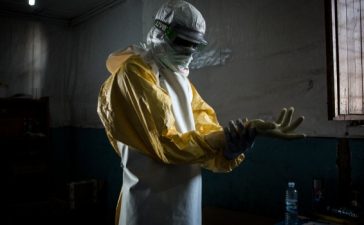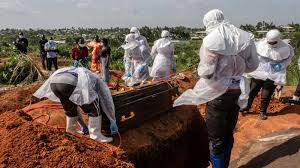
Health authorities in the Democratic Republic of Congo have raised concerns over the spread of Ebola after residents attacked a specialised burial team in South Kivu province, forcing responders to abandon a coffin and leaving a highly infectious body in the hands of community members.
The incident occurred on Monday in Katana, a town located about 30 kilometres north of Bukavu and currently under the control of AFC/M23 rebels.
According to the Congolese Ministry of Health, the attack targeted a safe and dignified burial team responsible for handling Ebola victims under strict protocols designed to prevent further transmission of the virus.
Following the assault, members of the community reportedly took charge of the body, a development health officials described as a major public health risk.
Safe burial procedures are considered a critical part of Ebola containment efforts because the bodies of victims remain highly infectious after death.
Health authorities said the circumstances surrounding the attack remain unclear, as officials have not yet identified the specific trigger for the violence.
The incident highlights ongoing challenges facing health workers and response teams as they seek to contain the latest Ebola outbreak in eastern Congo.
Mistrust, misinformation and resistance from some communities continue to hamper containment efforts, particularly in conflict-affected regions where public confidence in authorities remains fragile.
The attack in Katana was not an isolated event.
In a separate incident on the same day in Bunia, the capital of Ituri province, residents reportedly assaulted another Ebola response team at a cemetery.
According to local reports, at least four people were injured during the confrontation.
Health officials said some family members of Ebola victims have questioned official diagnoses and resisted public health measures, including safe burial procedures and contact tracing activities.
The latest outbreak involves the Bundibugyo strain of Ebola and was officially declared on May 15.
Since then, the Democratic Republic of Congo has recorded 363 confirmed cases and 62 deaths, according to the latest figures released by the Ministry of Health.
Authorities recently reported 19 new confirmed infections, including two deaths, indicating that transmission remains active across several areas.
The outbreak has now spread to 17 of the 36 health zones in Ituri province.
Cases have also been confirmed in seven health zones in North Kivu province and one health zone in South Kivu province.
Despite the growing number of infections, health officials say some progress has been recorded in monitoring and controlling potential transmission chains.
The ministry reported that 32 individuals identified as contacts of confirmed Ebola cases in Ituri’s Rwampara area completed a 21-day observation period without developing symptoms of the disease.
In North Kivu, authorities also announced plans to discharge a patient who had successfully recovered from Ebola treatment in the city of Goma.
According to local officials, the recovered patient was reunited with family members after completing treatment and medical observation.
International organisations continue to support containment efforts across the affected provinces.
The International Organization for Migration is assisting authorities in establishing 30 health control posts across Ituri, North Kivu and South Kivu.
The checkpoints are intended to monitor population movements, identify suspected cases and reduce the risk of further spread.
Speaking on the initiative, regional officials said the monitoring system would help detect infections early and strengthen surveillance in high-risk communities.
Meanwhile, humanitarian organisations are continuing to deliver medical supplies to outbreak zones.
The International Federation of Red Cross and Red Crescent Societies confirmed that enough equipment for 300 safe and dignified burials arrived in Bunia on June 3.
Health experts warn that community cooperation remains essential to containing the outbreak, stressing that attacks on health workers and burial teams could undermine efforts to break chains of transmission and bring the epidemic under control.