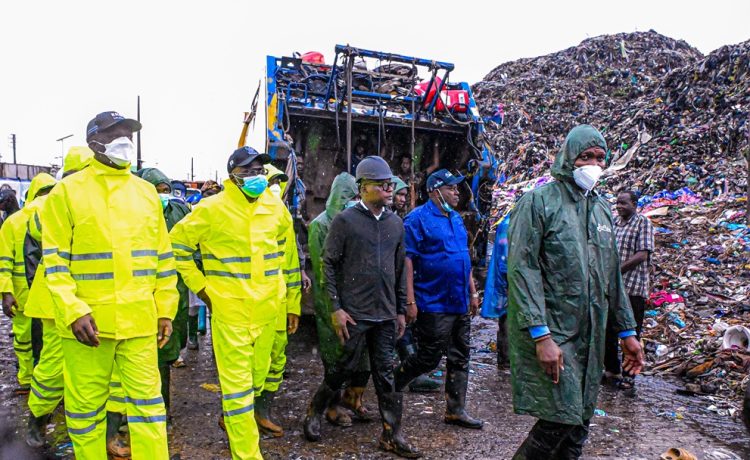
Lagos State Governor, Babajide Sanwo-Olu, has declared a state of emergency in waste collection and announced a series of immediate and longer-term measures aimed at addressing mounting refuse evacuation challenges across the state.
The Governor also ordered reforms in the organisational structure of the Lagos State Waste Management Authority, LAWMA, after expressing dissatisfaction with what he described as inefficient supervision of the waste management system.
Sanwo-Olu announced the measures during an inspection of the Olusosun dumpsite in Ojota on Wednesday, accompanied by his deputy, Dr Obafemi Hamzat, despite heavy rainfall.
The visit included discussions with waste management stakeholders and an assessment of the operational difficulties affecting municipal waste collection and disposal.
Sanwo-Olu acknowledged that refuse collection had slowed in parts of Lagos in recent weeks, blaming some of the difficulties on the inability of Private Sector Participation, PSP, waste operators to meet agreed collection obligations.
He also warned residents against dumping refuse in unauthorised locations, directing that offenders caught engaging in indiscriminate waste disposal should be prosecuted immediately.
Olusosun, Solous Capacity to Be Expanded
A major part of the intervention involves ongoing waste compaction and infrastructure works at the Olusosun and Solous 3 dumpsites.
According to Sanwo-Olu, fire incidents at the dumpsites disrupted activities, but contractors have since returned to the sites to clear and prepare them for increased daily waste disposal.
Upon completion of the ongoing works, the government expects each dumpsite to be capable of receiving about 450 trucks of municipal waste daily, substantially increasing disposal capacity available to PSP operators.
The state is also stabilising roads leading into five dumpsites to improve truck access and accelerate turnaround times.
Sanwo-Olu directed the rehabilitation of access roads to the dumpsites at Ewu Elepe and Oke Oso as part of the immediate response.
“In the past couple of weeks, we have seen pressure and slow turnaround in waste collection in different parts of the city,” the Governor said.
“We have seen residents throwing waste indiscriminately at undesignated areas in the city. We are here to see what the problem is and for us to be able to declare a state of emergency so that we can take the State out of this unpleasant situation.”
Lagos Orders 160 New Waste Compactors
The government is also moving to address shortages and ageing equipment among waste collection operators.
Sanwo-Olu disclosed that the state had ordered 160 modern waste compactors from abroad, with deliveries expected to begin soon.
Development partners working with LAWMA are expected to provide additional compactors, while the government plans to procure specialised landfill compactors for operations at disposal sites.
The Governor said the additional equipment would strengthen the capacity of PSP operators to collect waste from residential properties and roads and move it more efficiently to dumpsites.
“The other solution we are throwing into the mix is raising the capacity of the PSP operators,” Sanwo-Olu said.
“We currently have numbers of compactors that are not fit and proper for the size of the city. We have ordered 160 modern compactors and they will start coming in soon.”
The intervention reflects the scale of the operational challenge facing a rapidly growing megacity where the effectiveness of waste collection depends on sufficient trucks, accessible disposal facilities and reliable turnaround times.
Government Moves to Weed Out Weak PSP Operators
The reforms could also result in consolidation among private waste collectors.
According to Sanwo-Olu, the leadership of the PSP operators has agreed to reassess its membership and remove companies that lack the financial and operational capacity to perform effectively.
The Governor questioned the usefulness of maintaining a large number of operators if many cannot adequately perform their responsibilities.
“We don’t want to have a situation where we will have 800 PSP operators for a job that can only be done by 400 operators,” he said.
The government said it was prepared to work with operators to reduce the financial risks associated with purchasing additional trucks, helping viable companies expand their fleets without being overwhelmed by financing costs.
PSP operators have also indicated that they intend to acquire additional vehicles as the government increases the number of compactors available within the waste management system.
Any consolidation, however, would need to ensure that reducing the number of operators does not weaken coverage, particularly in densely populated and underserved communities.
Two 2,400-Tonne Transfer Stations Planned
Beyond the immediate evacuation of accumulated waste, Lagos is pursuing a longer-term shift in how refuse is processed.
Sanwo-Olu said the government, working with development partners, is developing a 2,400-metric-tonne Transfer Loading Station at Olusosun, with another facility of similar capacity planned for Solous 3 in Alimosho.
The two facilities are expected to receive more than 500 waste trucks daily.
Transfer loading stations are designed to provide an intermediate point where waste collected by smaller vehicles can be consolidated and compacted before being transported in larger quantities to processing or disposal facilities.
For Lagos, the strategy is intended to reduce pressure on dumpsites and make the movement of municipal waste more efficient.
Sanwo-Olu said access improvements around Solous 3 should be completed within two to three weeks.
Material Recovery Facilities Target Recycling
The state is also constructing two Material Recovery Facilities at Oke Oso in Epe and Erekiti in Badagry.
Under the proposed system, waste received at transfer loading stations would be compacted and subsequently transported to the recovery facilities for further sorting and recycling.
Sanwo-Olu said Lagosians should begin seeing physical infrastructure development at the transfer loading stations and recovery facilities before the end of 2026.
However, the facilities themselves are not expected to become operational immediately.
The Governor indicated that the infrastructure could be completed around the end of the first quarter or during the second quarter of 2027, depending on the progress of construction.
The proposed model represents an attempt to move Lagos beyond a system heavily dependent on collecting and dumping municipal refuse towards one incorporating waste sorting, material recovery and recycling.
If effectively implemented, recovery facilities could help reduce the amount of waste ultimately deposited at landfills while creating opportunities to extract reusable materials from the waste stream.
LAWMA Faces Organisational Reforms
Sanwo-Olu also turned attention to LAWMA itself, criticising what he described as inadequate supervision within the waste management system.
He said the agency would undergo organisational restructuring aimed at improving operational efficiency and accountability.
The proposed reforms suggest the administration sees Lagos’ current waste challenges as extending beyond equipment shortages and dumpsite capacity to weaknesses in management, enforcement and coordination.
The effectiveness of the emergency intervention will therefore depend on several components working simultaneously: functional collection trucks, viable PSP operators, accessible dumpsites, effective LAWMA supervision, enforcement against illegal dumping and completion of planned processing infrastructure.
For a city with a large and expanding population, reliable waste collection is also closely connected to public health, drainage management and environmental protection. Accumulated refuse can obstruct drainage channels and worsen environmental conditions, particularly during the rainy season.
Sanwo-Olu warned that enforcement would form part of the new approach, directing authorities to prosecute residents caught dumping waste at undesignated public spaces.
With the emergency measures now announced, attention will shift to implementation — particularly the arrival of the 160 compactors, restoration of dumpsite access, improved PSP performance and delivery of the transfer and material recovery infrastructure promised for 2027.