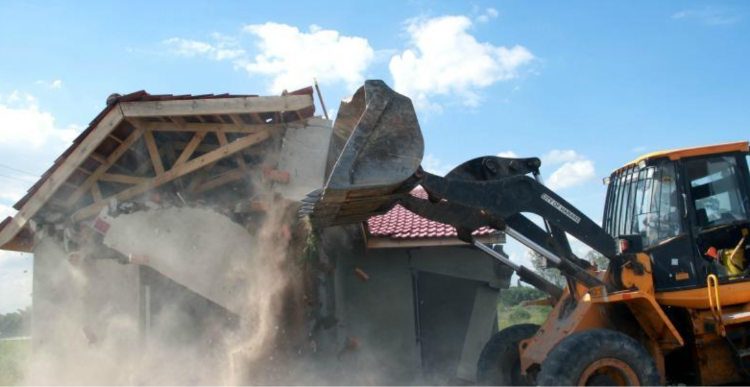
Several families in Harare, Zimbabwe’s capital, have been left homeless following the demolition of residential properties by municipal authorities, sparking renewed concerns about land administration, housing rights and government accountability.
The demolitions have affected residents of St Martins Extension, where several homeowners say they spent years saving money to acquire residential land and construct houses before their properties were destroyed.
In a report published on Tuesday, November 10, 2026, Al Jazeera highlighted the experiences of residents who said they obtained land through arrangements involving municipal authorities and subsequently invested their savings in building homes.
Among those affected is 28-year-old Methro Masunga, a single mother of three, who said she spent years working part-time jobs, including washing clothes and dishes in private homes, to save enough money to acquire a residential plot.
Masunga reportedly began making payments for her residential stand in 2015 and received an allocation in 2019. She said the arrangement was formalised through the city council in 2020, when residents began receiving official documents.
However, her home was demolished on August 14, 2026, during an operation involving bulldozers and municipal police officers.
The demolition left her and her children without permanent accommodation, reducing years of financial sacrifice to rubble.
Other residents have reported similar experiences, with some forced to return to rented accommodation while others have constructed temporary shelters within the affected community.
One of the affected residents, Joachim Nhete, said he used his retirement benefits to acquire land and build his house. He estimated that his total investment exceeded $10,000.
The demolitions have generated disagreement between homeowners and the Harare City Council over the legality of the residential developments.
Residents argue that they acquired their properties through recognised processes and received allocation letters and agreements of sale connected to the municipality.
However, city authorities maintain that the demolitions are intended to address illegal construction, disputed land transactions and structures built without the necessary planning approvals.
The municipality has argued that some residents continued building despite warnings that the land had not been properly approved or serviced for residential development.
Harare City Council spokesperson Stanley Gama reportedly said the authorities were targeting structures built illegally after owners had been warned against continuing construction.
The disagreement has placed the spotlight on the relationship between land allocation documents and building approvals.
Receiving an allocation letter or purchasing a residential stand does not automatically mean that every construction activity on the property has received the required planning permission.
Consequently, the legal status of individual properties and the documents issued to homeowners have become central to the dispute.
The controversy is also connected to previous legal proceedings involving residents of St Martins Extension.
On October 29, 2025, a consent order issued by Justice Happias Zhou set aside demolition notices affecting named applicants and restricted the city council from demolishing their homes without a valid court order.
However, the order did not automatically cover every property in the area. The available reporting does not establish whether all the residents affected by the latest demolitions were protected by that specific court decision.
Zimbabwe’s Constitution provides protection against unlawful eviction and demolition of homes without a court order made after consideration of relevant circumstances.
National housing policy also emphasises the importance of providing alternative accommodation before relocation and demolition exercises.
Affected residents have questioned whether sufficient procedures were followed and why alternative accommodation was not provided before their properties were destroyed.
The dispute reflects wider challenges in Harare’s land administration system.
A 2019 commission of inquiry chaired by Justice Tendai Uchena identified problems involving unauthorised land sales, weak administrative systems and poor record-keeping by local authorities.
Such challenges have contributed to uncertainty over land ownership and residential development in parts of the city.
The latest controversy has therefore increased calls for transparency, proper investigations and accountability from government institutions responsible for land allocation and urban planning.
Human rights organisations and residents’ representatives have also raised concerns about the social consequences of demolitions, particularly for low-income families who may have spent several years building their homes.
The Harare City Council has continued to defend its enforcement activities, while affected residents are seeking legal remedies and compensation for their losses.
The issue remains unresolved, with questions surrounding the validity of individual land documents, the authority of municipal officials and the protection of residents’ housing rights.
The developments have renewed the debate about the need for stronger land administration, transparent housing policies and better coordination between local authorities and residents.