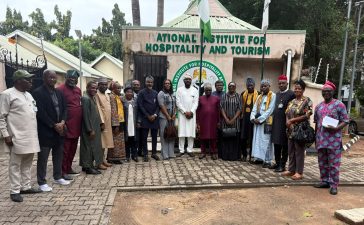
The Federation of Tourism Associations of Nigeria, FTAN, has inaugurated its South-East Zonal Executive Council with an ambitious agenda to transform the region’s tourism potential into measurable economic activity through increased investment, job creation, destination development and visitor growth.
The inauguration, held in Enugu on Sunday, September 6, 2026, brought together tourism stakeholders as the federation outlined plans for greater collaboration among the five South-East states — Enugu, Anambra, Abia, Imo and Ebonyi.
At the centre of the new administration’s strategy is a proposed unified South-East Tourism Circuit, designed to connect attractions and tourism experiences across the five states and market the region as an integrated destination rather than a collection of individual locations.
FTAN South-East Vice President, Wilson Uche Ugwu, said the new executive would place greater emphasis on implementation, accountability and measurable results.
“We intend to move beyond talking about potential to actually building a tourism economy around it,” Ugwu said.
Five-State Tourism Circuit Takes Priority
Ugwu said stakeholder consultations and destination mapping for the proposed tourism circuit would begin immediately, with the council targeting the development of an initial framework within six months.
The initiative is expected to identify tourism assets across the five states and explore how they can be packaged into connected travel experiences capable of encouraging visitors to spend more time within the region.
Rather than marketing destinations independently, FTAN wants operators and governments to build complementary tourism products that could potentially allow visitors to move across multiple states under coordinated itineraries.
Such an approach could also create opportunities for hotels, restaurants, tour operators, transport providers, cultural organisations, entertainment businesses and local communities positioned along the proposed routes.
The challenge will be turning that concept into commercially viable packages that travellers can easily discover, book and experience.
Security, Infrastructure Remain Major Concerns
FTAN identified security and investor confidence among the most significant barriers confronting tourism development in the South-East.
Infrastructure and policy gaps were also highlighted as issues requiring attention if the region is to attract greater private-sector capital.
Ugwu said the zonal leadership would strengthen engagement with state governments, security agencies, host communities and private businesses as part of efforts to address those constraints.
Security is particularly important to tourism because destination perception can influence travel decisions even when individual attractions remain viable.
Investment decisions in hospitality and tourism also tend to require long-term confidence in security, transportation, infrastructure and government policy.
The FTAN leadership is consequently positioning cooperation between the private and public sectors as a critical element of its strategy.
FTAN Plans Unified Digital Tourism Platform
Digital visibility forms another major component of the agenda.
The council plans to develop a unified digital tourism platform alongside a verified database of tourism attractions, businesses and other industry assets across the region.
FTAN also wants tourism experiences from the five states professionally packaged and promoted online.
The initiative could address one of the practical challenges confronting many emerging destinations: attractions may exist, but travellers often struggle to find reliable information about them, including transportation, accommodation, opening times, tour operators and booking options.
Creating a credible digital inventory could therefore help move the region from simply identifying attractions to developing tourism products that can be marketed and sold.
‘We Have a Tourism Conversion Problem’
Delivering the keynote address at the inauguration, Chief Ben Etiaba, FCA, argued that the fundamental challenge confronting tourism in the South-East was not an absence of attractions.
“The South-East does not have a tourism problem. We have a tourism conversion problem,” Etiaba said.
He proposed a five-point strategy built around Connect, Package, Digitalise, Invest and Empower.
According to him, the region needs to convert attractions into experiences, experiences into commercially sustainable businesses and those businesses into employment and prosperity.
The argument places tourism development beyond the traditional emphasis on simply identifying natural, historical or cultural attractions.
For destinations to generate meaningful economic returns, attractions generally need supporting services — from transportation and accommodation to tour packaging, entertainment, food, security, digital promotion and customer service.
FTAN’s proposed regional circuit is intended to provide a framework for connecting those components.
Badaki Calls for Private-Sector Leadership
FTAN President, Dr Aliyu Badaki, challenged the newly inaugurated council to translate its plans into concrete results.
“Let us see it in action that South-East is number one,” Badaki said.
He called on the council to unite tourism stakeholders, develop a clear implementation plan and engage governments and relevant agencies collectively rather than through fragmented interventions.
Badaki also emphasised the role of the private sector in developing commercially sustainable tourism products, while governments concentrate on providing an enabling environment through appropriate policies and infrastructure.
That public-private relationship could prove crucial to the success of the South-East agenda.
Government can improve roads, security, destination infrastructure and regulation, but tourism businesses ultimately need to develop products capable of attracting customers and generating sustainable revenue.
Council Sets Performance Benchmarks
Significantly, the new FTAN leadership has outlined benchmarks against which it wants its tenure assessed.
Ugwu said stakeholders should measure the council’s performance through three major outcomes: establishment of a functioning five-state tourism circuit, increased tourism investment and job creation, and development of a stronger South-East destination brand accompanied by measurable visitor growth.
“Stakeholders should judge us by what changed on the ground — not by the number of meetings we held,” he said.
The emphasis on measurable outcomes could become particularly important as the council moves from inauguration to implementation.
Its immediate six-month target for a preliminary tourism-circuit framework provides an early benchmark, while the longer-term test will be whether the initiative attracts private investment, creates bookable tourism products and increases visitor movement across the five states.
FTAN South-East says its broader ambition will be pursued under the vision: “One Region. One Voice. One Tourism Vision.”
If successfully implemented, the initiative could provide a more coordinated framework for positioning the South-East as a regional tourism destination while expanding the sector’s contribution to employment, local businesses and economic activity.