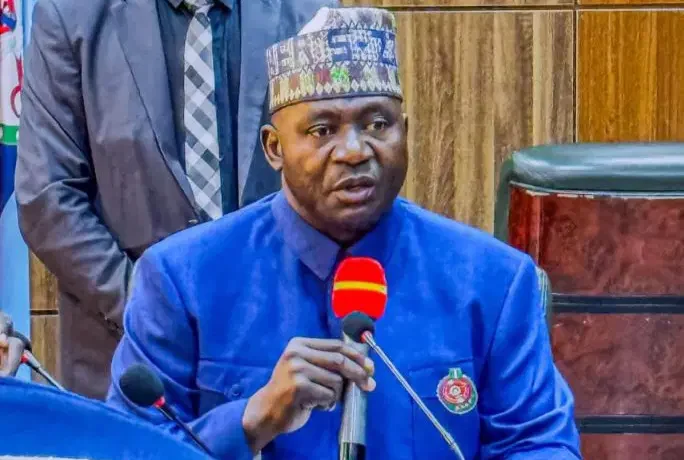
The Minister of Defence, Gen. Christopher Musa (retd.), has warned security agencies against relying on last-minute deployments to secure elections, saying effective election security requires months of planning and coordination.
Musa made the remarks on Tuesday while delivering the keynote address at the Blueprint newspaper seminar on security.
The minister said election security should not be treated as an activity limited to election day but as a continuous process that begins long before campaigns and continues after votes are counted.
He said successful election security depends on intelligence-led operations, inter-agency coordination, effective communication and continuous assessment of emerging threats.
According to Musa, security agencies must prepare early and develop strategies based on intelligence rather than respond only after incidents occur.
He also warned that the changing nature of security threats means election preparations must go beyond the physical protection of polling units.
The minister identified cyberspace, misinformation, economic hardship and the manipulation of ethnic and religious divisions as emerging threats that could undermine the integrity of elections.
He said the greatest threat to an election might no longer be an armed individual at a polling unit but an anonymous actor operating online to manipulate information and weaken public confidence in democratic institutions.
To strengthen election security, Musa proposed a six-pillar framework centred on strategic intelligence, digital security, civil-military coordination, unified strategic communication, a responsible information environment and engaged citizens.
He said strategic intelligence should serve as the foundation of election security planning, with security and electoral institutions relying on threat assessments, early warning systems and real-time information sharing.
Musa also stressed the importance of protecting digital infrastructure as elections become increasingly technology-enabled.
He said electoral systems, communication networks and information platforms must be protected against cyber intrusion, digital sabotage and malicious interference.
On civil-military coordination, the minister called for stronger collaboration among security agencies while respecting their constitutional responsibilities.
He said seamless coordination, interoperability and joint planning were more effective during national emergencies and major public events than institutional rivalry.
Musa identified unified strategic communication as another key pillar, warning that a lack of timely information could create room for misinformation.
He said coordinated and accurate public communication was necessary to maintain public confidence before, during and after elections.
The minister further said government alone could not defeat misinformation, stressing that the media, technology companies, civil society organisations, educational institutions and citizens all had a role to play in promoting fact-based public discourse.
He urged stakeholders to reject narratives capable of inciting violence or undermining confidence in democratic institutions.
Speaking at the event, former Zamfara State Governor AbdulAziz Yari warned politicians against using insecurity as a political tool to win public support.
Yari described the fight against insecurity as a collective national responsibility that extends beyond the government and security agencies.
He said political parties should recognise that insecurity should not be exploited for political advantage, adding that Nigerians were already aware of the security challenges facing the country.
Drawing from his experience as Zamfara governor between 2011 and 2019, Yari said insecurity had remained a persistent national challenge across successive administrations.
He referenced the administrations of former Presidents Olusegun Obasanjo, Umaru Musa Yar’Adua, Goodluck Jonathan and Muhammadu Buhari, as well as the current administration, arguing that the country needed fairness and justice in addressing the problem.
Musa’s warning comes amid growing concerns over the evolving nature of threats to Nigeria’s electoral process, particularly the potential impact of digital misinformation, cyber threats and politically motivated violence.
He stressed that early preparation, intelligence sharing and cooperation among relevant institutions would be critical to ensuring that future elections are secure and credible.