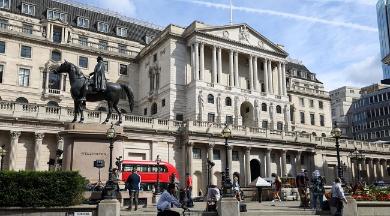
The Bank of England has maintained its benchmark interest rate at 3.75 per cent, choosing to hold steady despite persistent inflationary pressures linked to rising global energy prices following the US-Iran conflict.
The decision, announced on Thursday, was widely expected by analysts and comes amid a broader wave of monetary policy tightening and caution across major global central banks.
The Bank of England’s Monetary Policy Committee (MPC) voted to keep rates unchanged, although two members supported an immediate quarter-point increase to 4.0 per cent.
Governor Andrew Bailey said recent movements in oil prices offered some relief, but warned that inflationary pressures remain embedded in the economy.
“Oil prices have fallen in recent days, and that’s encouraging,” Bailey said. “But they’re still higher than before the war. Whatever happens in the future, the higher energy prices of the past four months mean there’s already some inflationary pressure in the pipeline.”
Britain’s inflation rate held at 2.8 per cent in May, significantly above the Bank’s two per cent target, according to official data. The central bank reiterated its mandate to prevent high inflation from becoming entrenched in the economy.
“Our job is to make sure that higher inflation does not persist and have long-lasting effects on the economy,” the Bank said in its statement.
The rate decision came amid divergent global monetary policy moves. The Federal Reserve has signalled a possible rate increase later this year, even as it held borrowing costs steady on Wednesday.
Meanwhile, the Bank of Japan raised interest rates to a 31-year high earlier this week in response to inflationary pressures linked to global energy shocks. The European Central Bank also recently increased its benchmark rate for the first time since 2023.
The Bank of England said it would continue monitoring labour market conditions and broader economic indicators, including unemployment trends.
Data from the Office for National Statistics showed UK unemployment easing to 4.9 per cent in the three months to April, while youth unemployment remained above 16 per cent. A government-backed review has warned that over one million young people are currently not in education, employment or training, raising concerns about long-term labour market risks.
Economists say the UK economy remains under pressure from high energy costs and weak growth, with output contracting slightly in April. Although global tensions appear to be easing, domestic political uncertainty is also weighing on sentiment.
Political instability within the UK Labour Party has added to market unease, with leadership tensions intensifying following poor local election results and internal divisions over policy direction. Keir Starmer has faced mounting pressure since Labour’s setbacks in recent regional elections.
Analysts warn that while the decision to hold rates may offer short-term stability, the Bank of England’s future policy direction will depend heavily on energy prices, inflation trends, and labour market resilience in the coming months.
The MPC is expected to remain cautious as it balances inflation control with the risk of slowing economic growth in an already fragile global environment.