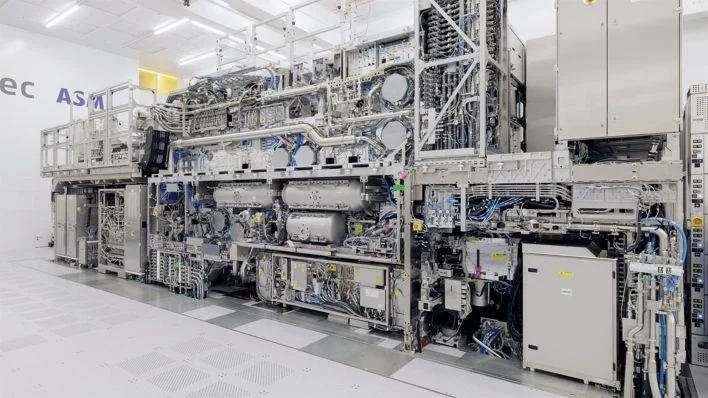
ASML is working with some of the world’s biggest semiconductor companies to overcome a major technical limitation in its newest chipmaking equipment as artificial intelligence drives demand for larger and increasingly complex processors.
The Dutch semiconductor equipment manufacturer plans to collaborate with companies including Nvidia, Intel, Taiwan Semiconductor Manufacturing Company and Samsung Electronics on technology that could allow its next-generation lithography machines to manufacture larger chips.
At the centre of the project is ASML’s High Numerical Aperture Extreme Ultraviolet lithography, or High NA EUV, technology.
The machines are designed to print smaller and more sophisticated features onto semiconductor wafers, potentially allowing chipmakers to pack greater computing capability into future processors.
AI Creates Demand for Larger Chips
Artificial intelligence has transformed the semiconductor industry by dramatically increasing demand for high-performance processors used in data centres.
AI accelerators require enormous computing power and are often significantly larger and more complex than processors used in smartphones and conventional consumer electronics.
ASML’s existing EUV machines can manufacture chips measuring up to about 800 square millimetres.
Its newer High NA systems can print finer features, but their current mask configuration limits the maximum size of chips that can be produced.
That creates a potential problem for manufacturers developing large AI and data-centre processors.
ASML now intends to develop larger masks for High NA equipment, allowing future machines to produce chips comparable in size to today’s large data-centre processors.
The company believes the modification could also increase system productivity by about 40 per cent.
Nvidia, Intel, TSMC Join Project
The participation of Nvidia is particularly significant because the US company has become one of the biggest beneficiaries of the global AI boom.
Its graphics processors and AI accelerators are widely used to train and operate advanced artificial intelligence models.
However, Nvidia does not manufacture most of its own chips, relying heavily on contract manufacturers including TSMC.
Intel is already using ASML’s newest equipment for laptop processors, while TSMC and Samsung are preparing to introduce High NA EUV technology into high-volume manufacturing over the coming years.
TSMC is expected to adopt the technology for large-scale production around 2028, while Samsung is targeting approximately 2030.
Memory-chip manufacturer SK Hynix has also expressed interest in joining the initiative and could use the larger-mask technology for advanced DRAM production.
ASML Holds Critical Position in Chip Industry
ASML occupies an unusual position in the global semiconductor supply chain.
The Dutch company is the world’s dominant supplier of advanced EUV lithography equipment required to manufacture leading-edge chips.
That makes its technology strategically important to semiconductor manufacturers and governments competing for leadership in artificial intelligence.
Its machines are among the most sophisticated industrial systems ever built, using extremely short-wavelength ultraviolet light to create microscopic patterns on silicon wafers.
As semiconductor features become smaller, the complexity and cost of producing each generation of processors continue to increase.
The development of High NA EUV represents the industry’s next major step.
ASML plans to pilot the larger-mask technology by 2031 and aims to have it ready for production around 2033.
While that timeline remains several years away, semiconductor companies are planning manufacturing technologies far in advance because new fabrication plants and production systems require billions of dollars and years of preparation.
The project therefore illustrates how today’s artificial intelligence boom is already influencing the design of semiconductor manufacturing equipment expected to be used well into the next decade.