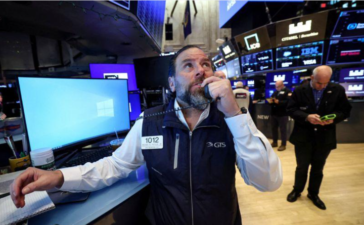
US stock markets suffered a major sell-off on Thursday, November 5, as technology shares linked to artificial intelligence recorded significant losses, raising concerns about investor confidence in the rapidly expanding AI industry.
The decline represented the steepest single-day fall for Wall Street since the market disruption caused by US tariff announcements in April 2025.
According to the Associated Press, the S&P 500 fell 4.4 per cent to 7,353.73 points, while the Dow Jones Industrial Average declined 3.4 per cent to 51,523.06 points.
The technology-heavy Nasdaq Composite recorded an even larger decline, dropping 5.5 per cent to 24,315 points.
The sell-off reflected growing concerns about the amount of money being invested in artificial intelligence infrastructure and whether companies would generate sufficient returns from the spending.
Investors also reacted to political developments in the United States, particularly concerns that recent Democratic election victories could increase regulatory pressure on the construction of data centres.
The decline affected several major technology companies and businesses connected to the artificial intelligence supply chain.
AI companies face investor pressure
Artificial intelligence has become one of the biggest investment themes in global financial markets.
Technology companies have committed substantial resources to developing AI models, building data centres and expanding computing capacity.
These investments have increased demand for semiconductor chips, electricity, cooling systems and other infrastructure required to operate AI services.
However, investors have become increasingly concerned about whether the expected financial returns will justify the scale of investment.
The latest market decline reflected these concerns.
According to AP, Nvidia shares fell 9.3 per cent, while Advanced Micro Devices declined 17.3 per cent.
GE Vernova, a company involved in energy infrastructure, also recorded a decline of 7.5 per cent.
The losses demonstrated how concerns surrounding artificial intelligence can affect companies beyond the traditional technology sector.
Data centres require significant electricity and infrastructure, making energy providers and industrial businesses important parts of the AI investment chain.
When investors become concerned about the pace of data-centre construction, the effects can spread across several industries.
Political developments add to market uncertainty
Political developments in the United States also contributed to investor concerns.
The recent Democratic election victories raised questions about whether governments could introduce additional restrictions or delays affecting data-centre construction.
Data centres have attracted increasing public attention because of their demand for electricity, land and water.
Some communities have expressed concerns about the environmental and infrastructure implications of hosting large facilities.
Investors are therefore monitoring the possibility of stricter regulations and delays to new projects.
Any slowdown in data-centre development could affect demand for semiconductors, power infrastructure and related technology services.
However, the election results do not automatically mean that construction projects will be suspended.
The market reaction reflects investor expectations and uncertainty rather than confirmation that new restrictions have already been implemented.
What happened to other market indicators?
The sell-off was not limited to technology stocks.
The Dow Jones Industrial Average and Russell 2000 also recorded substantial declines.
The Russell 2000, which tracks smaller US companies, fell 4.4 per cent.
Investors also moved towards safer assets, contributing to lower Treasury yields.
This reflected concerns about market volatility and uncertainty surrounding the outlook for corporate earnings.
Meanwhile, oil prices also attracted attention.
Brent crude rose 3.9 per cent amid uncertainty connected to the conflict involving Iran.
The combination of falling equities and rising oil prices illustrated the different pressures affecting global financial markets.
Implications for global investors
The sharp decline could influence investment decisions across international markets because US equities remain an important part of global investment portfolios.
A sustained decline in major technology shares could affect pension funds, institutional investors and individual shareholders with significant exposure to American equities.
It could also influence investment sentiment in other markets, particularly countries whose stock exchanges have large technology-related sectors.
However, one day of losses does not automatically indicate the beginning of a prolonged financial crisis.
Investors will continue to monitor company earnings, inflation, interest rates, technology spending and government policies.
The central question for the AI industry is whether the enormous investments being made in artificial intelligence will translate into sustainable profits.
As companies continue to expand their infrastructure, financial markets are likely to remain sensitive to announcements about investment costs, revenue growth and future demand.
The latest sell-off demonstrates that even industries associated with strong technological growth are not protected from changes in investor confidence.