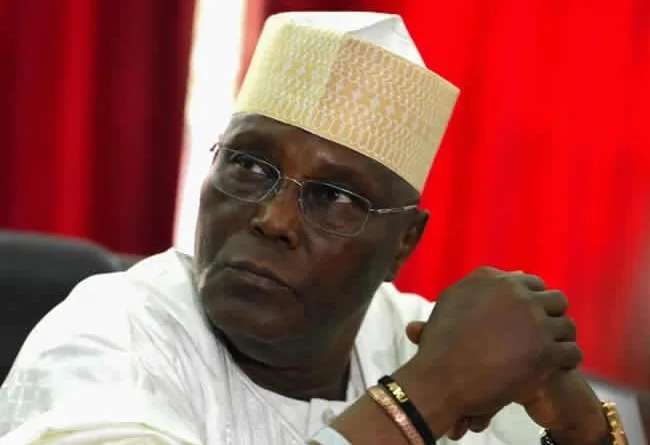
Former Vice President Atiku Abubakar has rejected President Bola Tinubu’s description of his proposed intervention in Nigeria’s petroleum sector as economically ignorant, accusing the administration of worsening the cost-of-living crisis while celebrating higher government revenues.
Atiku, in a statement issued on his behalf by his Senior Special Assistant on Public Communication, Phrank Shaibu, on Friday, said President Tinubu was not in a position to lecture Nigerians on economic management after the removal of petrol subsidy and the liberalisation of the foreign exchange market.
He argued that the policies were followed by higher inflation, transportation costs, petrol prices and household expenses.
“The real ignorance is believing suffering is economic policy. Tinubu removed the subsidy from Nigerians’ pockets, but he is yet to remove the questions from his books,” Atiku said.
The former vice president said his proposal was not a return to the subsidy regime that preceded the Tinubu administration but a targeted and temporary production-support mechanism designed to increase domestic refining and protect consumers from excessive price shocks.
He said the economic circumstances confronting Nigerians had changed substantially since Tinubu announced the removal of petrol subsidy in May 2023, making it necessary to reassess existing policy prescriptions.
“Economic prescriptions respond to prevailing conditions. But other things are no longer equal in Tinubu’s Nigeria,” Atiku said.
According to him, the removal of the subsidy without adequate measures to cushion its effects triggered a chain reaction across the economy, with petrol prices, transportation costs and food prices rising sharply while the naira also depreciated significantly.
“Atiku is not proposing the resurrection of the corrupt, open-ended subsidy bazaar. He proposes a targeted, capped, budgeted, time-bound and independently audited production-support mechanism tied to domestic production and protected against arbitrage,” the statement read.
Atiku’s comments came after President Tinubu criticised proposals to restore or introduce another form of petroleum subsidy, describing Atiku’s proposed model as a “demonstration of serious ignorance on governance and economy.”
Atiku accused the administration of adopting what he described as a rigid approach to subsidy removal despite the economic consequences that followed.
“Tinubu pronounced first and searched for a plan afterwards. Atiku studied the consequences and produced a solution,” the statement added.
The African Democratic Congress presidential candidate also challenged the Federal Government to explain continuing petroleum under-recoveries and energy-security costs recorded in the accounts of the Nigerian National Petroleum Company Limited.
He cited figures which he said amounted to approximately ₦17.5 trillion, including about ₦7.13 trillion classified as energy-security costs and ₦8.67 trillion in other petroleum-related obligations.
“If subsidy is dead, why are under-recoveries alive? If corruption was eliminated, why has opacity survived?” Atiku asked.
He argued that Nigerians were bearing the cost of the reforms through higher petrol prices and living expenses while questions remained over the financial obligations associated with the petroleum sector.
“Tinubu has given Nigerians the worst of both worlds: he removed the relief but retained the opaque costs. Nigerians got the pain; government kept the bill,” he said.
The Federal Government has consistently maintained that petrol subsidy had become financially unsustainable and that its removal was necessary to free resources for development, strengthen public revenues and reduce distortions in the petroleum market.
The administration has also pointed to higher allocations from the Federation Account as one of the benefits of the reform, particularly for state governments that previously struggled with salary obligations and other recurrent expenditure.
Atiku, however, dismissed that argument, saying increased allocations to governments should not be presented as evidence of economic success if ordinary Nigerians were simultaneously losing purchasing power.
“You do not build a federation by impoverishing citizens so that Abuja can send bigger cheques to governors,” he argued.
According to Atiku, increased Federation Account Allocation Committee disbursements could encourage states to depend more heavily on federal transfers instead of expanding their productive economies and internally generated revenues.
“Why undertake difficult reforms, industrialise or expand productive capacity when Abuja provides an ever-growing monthly cheque?” he asked.
“That is not fiscal federalism. It is fiscal sedation and rascality.”
He also renewed his demand for an explanation of approximately ₦30 trillion in Federation Account revenues, deductions, savings and transfers which he said he had previously asked the Federal Government to reconcile.
Atiku further questioned the ₦12.8 trillion Service-Wide Vote contained in the 2026 budget, arguing that the administration should demonstrate the same urgency it has shown in responding to political criticism when addressing questions about public finances.
“If Tinubu can mobilise an army of propagandists to attack Atiku within hours, surely he can find one accountant to explain his books,” he said.
Atiku maintained that the success of economic reform should ultimately be measured by its impact on citizens rather than by the size of government revenues.
“Economic reform is not measured by how fat government accounts become while citizens grow poorer,” he said, stressing that “An economy exists to serve human beings, not family and friends.”
He described the administration’s economic policies as an experiment that had imposed significant hardship on Nigerians and accused the presidency of confusing public endurance with evidence of policy success.
Atiku urged Nigerians not to accept what he described as another four years of policies that deepen hardship, insisting that his proposed petroleum-sector intervention was intended to support domestic production while gradually reducing the need for subsidy.
“Nigerians have paid enough for Tinubunomics. They should not be sentenced to another four years of the bitter experiment,” he stated.