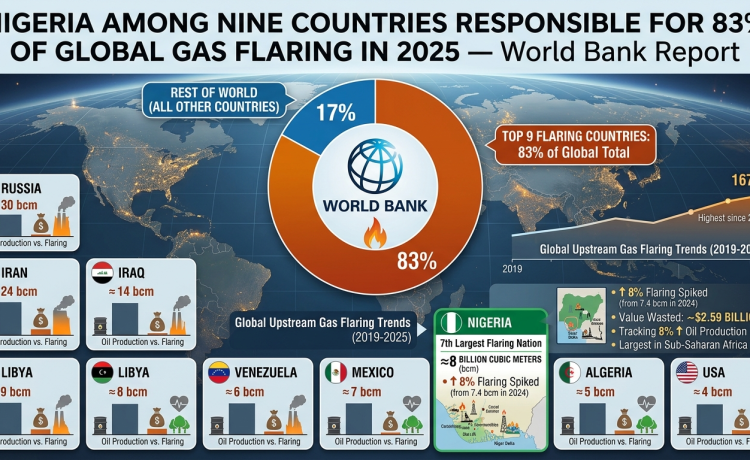
Nigeria has been identified as one of nine countries responsible for more than 83 per cent of global gas flaring in 2025, highlighting continued concerns over energy waste, environmental impact and the need for stronger measures to capture associated gas from oil production activities.
The disclosure was contained in the latest Global Gas Flaring Tracker Report released by the World Bank’s Global Flaring and Methane Reduction Partnership (GFMR) in collaboration with the Payne Institute for Public Policy at the Colorado School of Mines.
According to the report, Nigeria was listed alongside Russia, Iran, Iraq, Venezuela, Mexico, Libya, Algeria and the United States as the major contributors to global gas flaring.
The report revealed that although the nine countries accounted for only 46 per cent of global crude oil production, they were responsible for more than four-fifths of the world’s gas flaring activities.
Global Gas Flaring Continues to Rise
Gas flaring occurs when natural gas produced during crude oil extraction is burned rather than captured, processed or utilised for energy generation and industrial purposes.
The practice has remained a major environmental and economic concern because it releases greenhouse gases into the atmosphere while wasting a valuable energy resource.
The World Bank report showed that global gas flaring increased for the third consecutive year, rising from 157 billion cubic metres (bcm) in 2024 to 167 bcm in 2025.
The increase reflects continued challenges in reducing routine flaring, particularly in major oil-producing countries where infrastructure limitations, regulatory gaps and investment challenges affect gas utilisation.
Environmental experts have consistently warned that persistent gas flaring contributes to climate change, air pollution and health risks for communities located near oil-producing regions.
Nigeria’s Long Battle Against Gas Flaring
Nigeria has for decades attempted to reduce gas flaring through policy reforms, regulatory measures and investments aimed at improving gas utilisation.
The country has introduced several initiatives designed to encourage oil companies to capture associated gas and redirect it towards power generation, industrial use and export opportunities.
The Federal Government has also promoted gas as a transition fuel and a key component of Nigeria’s energy security strategy.
However, despite these efforts, gas flaring remains a significant challenge, particularly in the Niger Delta region where much of Nigeria’s oil and gas production takes place.
Industry stakeholders have identified inadequate infrastructure, including gas processing facilities and pipelines, as major barriers limiting the ability of operators to commercialise associated gas.
Economic Cost of Gas Flaring
Beyond environmental concerns, gas flaring represents a major economic loss for Nigeria.
Natural gas that could be converted into electricity, used as industrial feedstock or exported for revenue generation is instead burned.
With Nigeria facing persistent electricity challenges, energy experts argue that reducing gas flaring could help increase domestic gas supply and support power generation.
The country has one of the largest natural gas reserves in Africa, yet millions of Nigerians continue to experience unreliable electricity supply.
Analysts believe that improving gas infrastructure and accelerating investment in gas processing could help Nigeria unlock greater economic value from its natural resources.
Government Efforts and Regulatory Measures
The Nigerian government has continued to emphasise its commitment to ending routine gas flaring.
Regulatory agencies have introduced penalties and monitoring mechanisms aimed at discouraging operators from unnecessary flaring.
The implementation of the Petroleum Industry Act 2021 also created new frameworks for improving transparency and accountability within the oil and gas sector.
Furthermore, the government has promoted initiatives focused on gas commercialisation, including projects designed to expand liquefied natural gas production and domestic gas utilisation.
However, industry experts argue that stronger enforcement and increased investment will be required to achieve meaningful reductions.
Energy Transition Pressure Intensifies
The latest global gas flaring figures come at a time when oil-producing nations face increasing pressure to reduce emissions and align with global climate commitments.
Investors and international energy organisations are placing greater emphasis on environmental sustainability, methane reduction and responsible resource management.
For Nigeria, reducing gas flaring could improve its environmental performance while creating additional economic opportunities.
Experts say captured gas can support industries, improve electricity supply and create employment opportunities across the energy value chain.
Outlook for Nigeria’s Oil and Gas Sector
The World Bank report presents a renewed challenge for Nigeria as it seeks to position natural gas as a driver of economic growth.
While the country has made progress in developing gas projects, the continued ranking among major global flaring contributors highlights the urgency of accelerating reforms.
Reducing gas flaring will require collaboration between government agencies, oil companies, investors and local communities.
As global attention shifts towards cleaner energy practices, Nigeria’s ability to transform wasted gas into productive economic assets will remain a critical measure of progress within its oil and gas sector.