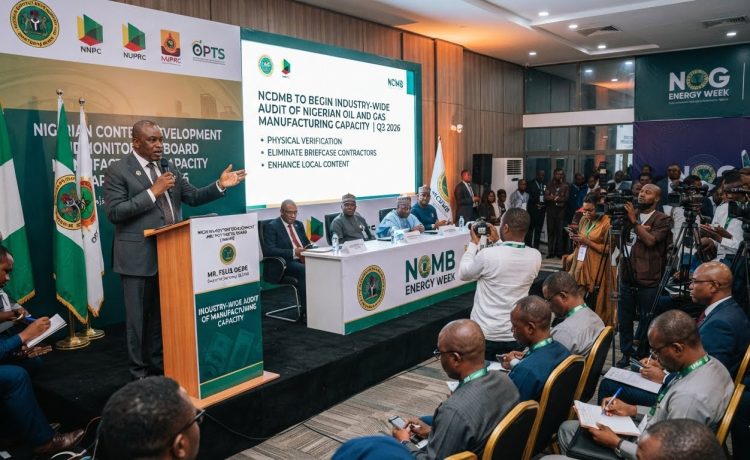
The Nigerian Content Development and Monitoring Board (NCDMB) has announced plans to commence a comprehensive industry-wide audit of local manufacturing and service capacities within Nigeria’s oil and gas sector in the third quarter of 2026.
The initiative, according to the agency, is designed to create a clearer picture of Nigeria’s industrial capabilities, eliminate unnecessary intermediaries in oil and gas contracting processes and ensure that qualified local companies gain direct access to business opportunities.
The Executive Secretary of the NCDMB, Felix Ogbe, disclosed this on Monday at the 25th Nigeria Oil and Gas (NOG) Energy Week in Abuja.
Ogbe explained that the audit would form part of a broader effort to strengthen Nigerian Content implementation and improve the participation of indigenous companies across the oil and gas value chain.
Audit to Identify Local Industry Capacity
According to the NCDMB, the exercise will assess the actual manufacturing and service capabilities of Nigerian companies operating within the oil and gas sector.
The audit is expected to provide updated information on local firms, including their technical capacity, production capabilities, operational readiness and ability to execute industry projects.
For years, industry stakeholders have raised concerns about the gap between Nigeria’s local content objectives and the actual level of participation by indigenous businesses.
While several Nigerian companies have developed capacity in areas such as engineering, fabrication, logistics, maintenance and technical services, many still struggle to secure major contracts.
The NCDMB believes the new audit will help address this challenge by creating a reliable database of competent local operators.
Reducing the Role of Middlemen
One of the major objectives of the initiative is to reduce the influence of intermediaries in oil and gas contracting.
Ogbe stated that the framework would ensure that businesses requiring services in the industry can directly identify and engage qualified Nigerian companies.
According to him, unnecessary layers in contracting processes often limit opportunities for genuine local businesses while increasing project costs.
By improving visibility of local capacity, the NCDMB hopes to create a more transparent system where companies with proven capabilities can compete effectively.
The move is expected to encourage greater investment in local manufacturing and service delivery while strengthening confidence in Nigeria’s indigenous oil and gas ecosystem.
Collaboration Among Key Industry Stakeholders
The NCDMB said the audit framework was developed through collaboration among major stakeholders in the oil and gas sector.
The participating organisations include the NCDMB, the Nigerian Upstream Petroleum Regulatory Commission (NUPRC), the Nigerian Midstream and Downstream Petroleum Regulatory Authority (NMDPRA), the Nigerian National Petroleum Company Limited (NNPC Ltd), National Petroleum Investment Management Services (NIPEX) and the Oil Producers Trade Section (OPTS).
The agency explained that the organisations have worked together over the past year to create a harmonised approach that will improve industry coordination.
As part of preparations for the exercise, participating agencies are expected to modify their certification portals to support a unified assessment system.
This will enable companies operating in the sector to undergo a more consistent evaluation process.
Boosting Nigerian Content Development
Nigeria’s local content policy was introduced to increase indigenous participation in the oil and gas industry and reduce dependence on foreign expertise and imported services.
Over the years, the sector has recorded growth in areas such as fabrication, engineering services, marine operations and equipment supply.
However, industry experts argue that more needs to be done to ensure local companies gain access to high-value contracts.
The NCDMB has consistently maintained that building domestic capacity remains essential to retaining more value from Nigeria’s oil and gas resources.
The upcoming audit is expected to support this objective by identifying gaps, highlighting opportunities and guiding future investments.
Potential Impact on Indigenous Businesses
For Nigerian oil and gas service providers, the audit could provide greater visibility and improve access to industry opportunities.
Small and medium-sized companies, which often face difficulties competing with larger international firms, may benefit from a more structured system that recognises verified local capabilities.
Industry analysts believe that improved access to contracts could stimulate investment, create jobs and encourage technology development within Nigeria.
Furthermore, a stronger local supply chain could reduce project delays and minimise dependence on imported services.
Challenges and Expectations
While the initiative has received positive attention, stakeholders say effective implementation will determine its success.
They emphasise the need for transparency, accurate data collection and consistent enforcement of local content requirements.
Companies also expect the process to be fair, ensuring that certification is based on genuine capacity rather than administrative compliance alone.
The NCDMB will need to maintain strong collaboration with operators, regulators and industry players to achieve the objectives of the exercise.
Outlook for Nigeria’s Oil and Gas Industry
The planned industry-wide audit represents another step in Nigeria’s efforts to deepen local participation in the energy sector.
As the country seeks to attract investment while maximising domestic benefits from its natural resources, strengthening local capacity will remain a critical priority.
If successfully implemented, the initiative could improve contracting efficiency, support indigenous businesses and create a more competitive Nigerian oil and gas industry.
The Q3 2026 audit is therefore expected to serve as a major benchmark in measuring the progress of Nigeria’s local content development strategy.