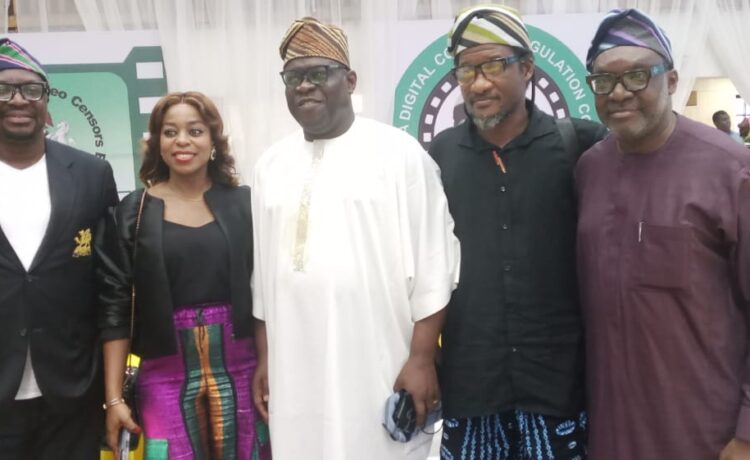
The National Film and Video Censors Board (NFVCB) has commenced the sixth edition of the Peace Anyiam-Osigwe Nigeria Digital Content Regulation Conference (PAO-NDCRC) in Lagos, bringing together prominent filmmakers, actors, content creators, regulators and other stakeholders to discuss the future of Nigeria’s creative industry in the digital era.
The two-day conference opened on Wednesday, November 18, 2026, at the Shell Hall, MUSON Centre, Onikan, Lagos, under the theme, ‘Film and Content Production in the Digital Era: Balancing Regulation and Innovation.’
The event, organised by the NFVCB under the leadership of its Executive Director and Chief Executive Officer, Dr Shaibu Husseini, featured a keynote address by celebrated Nigerian actor and filmmaker Richard Mofe-Damijo, popularly known as RMD.
Filmmaker Kunle Afolayan was among the speakers, while Judith Audu and Fidelis Duker participated as panellists. Other notable industry figures in attendance included Tunde Kelani, Femi Odugbemi, Norbert Young, Fred Amata, Keppy Ekpenyoung, Kazim Adeoti, Segun Arinze, Sandra Oyewole, Olumide Iyanda, Ijeoma Onah and Adetutu Laditan.
In his welcome address, Husseini highlighted the rapid transformation of the film and entertainment industry, noting that the expansion of social media platforms, digital distribution channels and emerging production technologies had created significant opportunities for filmmakers and content creators.
However, he explained that these developments had also introduced challenges relating to intellectual property protection, content ownership, professional standards and consumer protection.
Reflecting on his two years and eight months in office, the NFVCB chief executive outlined several initiatives aimed at modernising the board’s operations and strengthening its regulatory framework.
One of the major announcements was that the board had secured its first permanent headquarters after 28 years of existence.
According to Husseini, the building is expected to be completed by January 2, 2027. The development represents an important step towards improving the board’s institutional capacity and providing a permanent base for its regulatory activities.
He also highlighted the implementation of the 2024 regulations concerning the control of the promotion and glamourisation of tobacco, narcotics and ritual killings in films and other audiovisual content.
On digital transformation, Husseini disclosed that the board was working towards digitising its operations, including the preservation and transfer of records of films classified since 1994.
He stressed that regulation should create an environment where creativity and technological advancement could thrive without compromising public responsibility.
According to him, the sustainable development of Nollywood would require collaboration among regulators, filmmakers, investors and other industry stakeholders.
He further urged industry players to support an environment where regulation would not restrict innovation and technological advancement would not undermine responsibility.
In her remarks, the Minister of Art, Culture, Tourism and the Creative Economy, Hannatu Musa Musawa, commended the NFVCB and stakeholders in the film and digital content industry for their contributions to the creative economy.
She also acknowledged the legacy of the late Peace Anyiam-Osigwe, whose contributions to African cinema continue to inspire conversations about storytelling, creativity and the international relevance of the continent’s film industry.
Delivering the keynote address, Mofe-Damijo called for a balance between creative freedom and responsible regulation, noting that technological developments were rapidly changing how films and audiovisual content were produced, distributed and consumed.
He emphasised that the digital revolution was creating new opportunities for the entertainment industry but also required stakeholders to strengthen audience protection, maintain professional standards and preserve the integrity of the creative environment.
The actor argued that regulation should protect the public and respect the rights of content creators without limiting their ability to explore new ideas and develop innovative productions.
He further stressed the importance of intellectual property protection, fair compensation for creators and stronger measures against piracy as Nollywood continues to expand its presence across digital platforms.
According to him, the industry must build a sustainable system where filmmakers can compete internationally while retaining the economic value of their creative works.
The conference also provided a platform for discussions on the changing relationship between technology, regulation and the entertainment business, particularly as streaming services and digital distribution continue to reshape the global film industry.
Issues surrounding artificial intelligence in content creation, content monetisation, digital safety, ownership rights and professional production standards remain important considerations for the industry’s development.
The annual conference is named after the late Peace Anyiam-Osigwe, a renowned filmmaker and founder of the Africa Movie Academy Awards, in recognition of her contributions to African cinema.
The 2026 edition reinforces the need for cooperation between regulators and creative professionals as Nigeria seeks to strengthen its position in the global entertainment market.
With the announcement of a permanent headquarters and ongoing efforts to digitise its operations, the NFVCB says it is working towards a more modern regulatory structure that supports the growth of the Nigerian film industry while protecting audiences and creators.