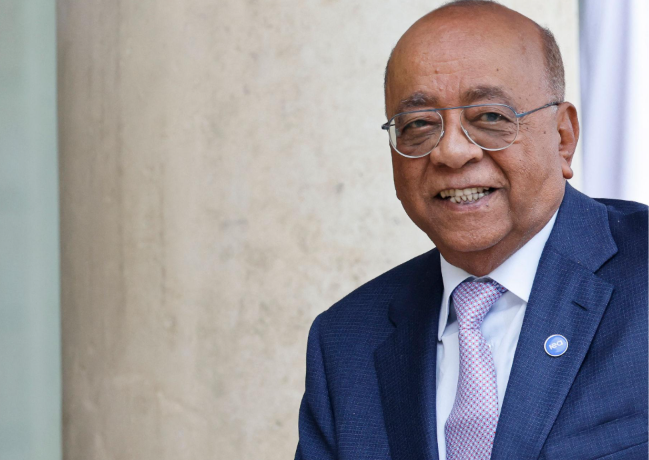
African governments should treat the decline in foreign aid as an opportunity to take greater control of their economic development, British-Sudanese philanthropist Mo Ibrahim has said.
Ibrahim, who made his fortune in the telecommunications industry before becoming involved in philanthropy, urged African countries to strengthen domestic revenue generation, address tax loopholes and make better use of resources within their economies.
His comments come at a time when international development assistance is facing significant reductions, creating concerns about how African countries will finance healthcare, education, infrastructure and other essential public services.
Speaking to Reuters, Ibrahim argued that African governments should not continue to depend heavily on foreign donors to finance their development programmes. Instead, he said governments must improve how they collect and manage revenue while ensuring that resources generated within their countries are used more effectively.
The philanthropist’s position reflects a wider debate about the sustainability of Africa’s development financing model, particularly as donor countries review their spending priorities.
According to the Reuters report, global aid fell by 23.1 per cent in 2025, representing the largest annual decline on record. The reduction has raised concerns about the ability of developing countries to maintain programmes that depend significantly on international assistance.
Ibrahim said African governments needed to address the financial leakages that prevent the continent from retaining and using its wealth.
One of the major issues he identified was capital flight, which involves money leaving a country through legal or illegal channels rather than being invested in its domestic economy.
He also called for stronger action against illicit financial flows and tax avoidance by multinational companies. These practices can reduce the amount of revenue governments collect, particularly in countries where extractive industries play a major role.
Africa loses an estimated $90 billion annually through capital flight, according to figures cited in the Reuters report. Ibrahim argued that the amount highlights the need for governments to strengthen financial oversight and improve the management of national resources.
He also called for African countries to reconsider the use of tax incentives and tax holidays where they do not deliver sufficient economic benefits.
Tax incentives are often introduced to attract foreign investors, encourage industrial development and create employment. However, governments risk losing substantial revenue when such incentives are poorly designed or granted without clear economic returns.
Ibrahim’s recommendations also include making better use of pension funds and sovereign wealth funds to support productive investments within African economies.
Such funds could help finance infrastructure, businesses and other development projects if managed transparently and responsibly.
His comments were also linked to findings from the 2026 Ibrahim Index of African Governance, produced by the Mo Ibrahim Foundation.
The index examines governance across the continent, including economic opportunities, human development, security, the rule of law and respect for civil rights.
The 2026 assessment found modest overall progress in governance over the past decade. However, improvements in some areas were accompanied by deterioration in security, the rule of law and civil liberties.
Ibrahim expressed concern about countries experiencing instability across a broad area stretching from the Atlantic coast through the Sahel towards the Horn of Africa.
He warned that worsening insecurity and governance challenges could make some countries increasingly difficult to govern.
He also identified concerns about the direction of governance in Nigeria and the continued decline in South Africa, according to Reuters.
The challenges facing African economies are not limited to reduced foreign assistance. Many governments are also dealing with high public debt, unemployment, currency pressures, limited industrial capacity and rising demand for public services.
These pressures make domestic revenue mobilisation increasingly important.
However, reducing dependence on foreign aid does not mean that international cooperation should end. Development partners continue to play important roles in areas such as humanitarian assistance, public health, education, climate financing and infrastructure development.
The central argument raised by Ibrahim is that African governments need stronger domestic systems so that essential development programmes are not excessively exposed to decisions made by foreign donors.
For the continent, achieving this objective will require more than increasing tax collection. Governments will also need to improve transparency, strengthen public institutions, reduce corruption and ensure that public resources deliver measurable benefits.
Investors and citizens are more likely to support domestic development efforts when they have confidence in how public money is managed.
African governments will therefore face an important test: whether they can turn the decline in foreign assistance into an opportunity to build stronger, more financially independent economies.