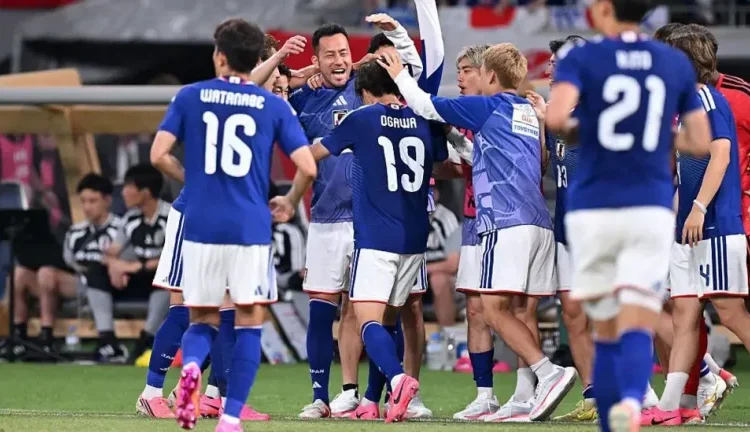
Japan secured a narrow 1-0 victory over Iceland in an international friendly, with the decisive moment influenced by a new substitution rule introduced by football’s lawmakers ahead of the upcoming World Cup.
The match took a dramatic turn late in the second half when Iceland were briefly reduced to 10 players after a delay in executing a substitution under new International Football Association Board (IFAB) regulations aimed at reducing time-wasting and improving game flow.
According to BBC Sport, the updated rule requires any substituted player to leave the pitch within 10 seconds and exit via the nearest point. If the rule is not followed, the incoming substitute is not permitted to enter immediately, forcing the team to continue temporarily with 10 players until the next stoppage and at least one minute of play has passed.
Iceland ran into difficulty during a late change when winger Isak Thorvaldsson was set to enter the match but was held up as his teammate failed to exit the field within the required time frame. As a result, the team was forced to continue briefly with a numerical disadvantage.
Japan quickly capitalised on the situation. Less than two minutes after Iceland were reduced to 10 men, striker Koki Ogawa scored the only goal of the match in the 87th minute, heading home to seal victory for the hosts.
The goal came 1 minute and 54 seconds after the substitution breakdown, highlighting how quickly the new rule can impact match outcomes.
Following the game, Japan head coach Hajime Moriyasu praised his team’s discipline in adapting to the new regulations but warned that such situations could easily go against them in future matches.
“The players handled the new rule adjustments today with almost no issues,” Moriyasu said. “But under the new rules, substitutions won’t always be as straightforward as before. We need to stay alert so we don’t create openings for the opponent.”
He also highlighted the growing tactical importance of additional regulatory changes, including three-minute hydration breaks, which are being introduced to provide coaches with brief windows for instructions during matches.
The friendly formed part of broader trials of new IFAB regulations ahead of the World Cup, which also include stricter time limits for throw-ins and goal kicks, mandatory off-field treatment for injured players, and expanded VAR intervention protocols.
The match between Japan and Iceland offered an early demonstration of how small procedural details could have major competitive consequences in modern football.
For Iceland, a brief delay proved costly. For Japan, it was a reminder that in the evolving game, even seconds can determine results.