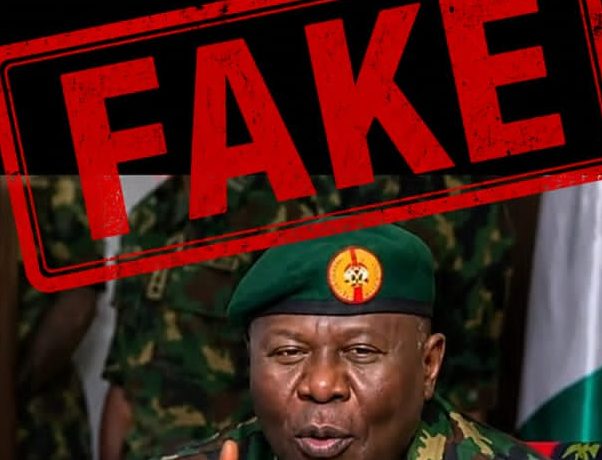
The Defence Headquarters (DHQ) has dismissed a fabricated artificial intelligence-generated video allegedly portraying the Chief of Defence Staff (CDS), General Olufemi Oluyede, as making statements suggesting support for partisan political interests.
The military authorities described the video as fake and said it did not originate from the Chief of Defence Staff or any official channel of the Armed Forces of Nigeria.
The development has raised fresh concerns over the growing use of artificial intelligence and digital manipulation to create misleading content involving public officials and senior security personnel.
In a statement issued by the Director of Defence Information, Major General Samaila Uba, the Defence Headquarters urged members of the public to completely disregard the video and avoid circulating it further.
The DHQ said the material was deliberately manipulated to deceive the public, misrepresent the position of the Chief of Defence Staff and damage the reputation of the Armed Forces.
DHQ Says Video Is Completely Fake
According to the Defence Headquarters, the statements attributed to General Oluyede in the video were false.
The military authorities stressed that the CDS did not make the comments contained in the manipulated footage.
The statement comes amid growing concerns about the ability of artificial intelligence tools to produce convincing audio and video content that can make individuals appear to say or do things they never actually said or did.
Such technology has created new challenges for governments, security agencies, journalists and members of the public who rely heavily on social media for information.
The latest incident involving the CDS demonstrates how fabricated digital content can potentially be used to create confusion around sensitive national issues.
Military Reaffirms Its Apolitical Position
One of the major concerns raised by the fabricated video is its apparent attempt to portray the military leadership as taking a partisan political position.
The Defence Headquarters rejected that portrayal.
The military reaffirmed that the Armed Forces of Nigeria remains a professional, apolitical and non-partisan institution.
According to the DHQ, the Armed Forces remains committed to the Constitution of the Federal Republic of Nigeria and its responsibility to defend the country.
The clarification is particularly significant because statements attributed to senior military officers can carry considerable weight, especially when they concern political issues.
A false impression that the country’s military leadership has endorsed a political position could potentially create unnecessary tension and undermine confidence in the institution.
AI Creates New Challenge for Information Verification
The incident has also highlighted the growing challenge posed by AI-generated misinformation.
Unlike traditional forms of fake news, manipulated videos can appear highly convincing.
A fabricated recording can combine a real person’s face, voice and mannerisms with entirely false words or actions.
This makes it increasingly difficult for ordinary social media users to distinguish authentic content from manipulated material.
The problem becomes more serious when such content involves senior government officials, military commanders or other influential public figures.
A misleading video can spread rapidly before authorities have an opportunity to issue a correction.
By the time the original claim is debunked, thousands or even millions of people may already have encountered it.
DHQ Warns Against Amplifying Fake Content
The Defence Headquarters condemned the creation and circulation of the fabricated video and warned those responsible, as well as individuals knowingly amplifying such material, to stop.
The warning comes as social media platforms continue to play a central role in the way Nigerians receive and share information.
The military urged the public to exercise caution when encountering videos or statements allegedly involving senior military officials.
Rather than relying solely on social media posts, users were encouraged to verify sensitive information through official Defence Headquarters communication channels.
This is particularly important when content relates to national security, military operations or political statements attributed to serving officers.
Public Urged to Rely on Official Channels
The DHQ listed its verified communication platforms through which members of the public can obtain authentic information.
These include its official Facebook page, Defence Headquarters Nigeria; its X account, DHQNigeria; Instagram account, DefenceHQ; WhatsApp channel, Defence Headquarters Nigeria; and YouTube channel, DefenceTV-Nigeria.
The military’s advice effectively places responsibility on members of the public to verify information before sharing it.
For journalists, bloggers and online publishers, the development also reinforces the importance of checking the authenticity of sensitive claims before publication.
Growing Threat of Deepfakes
The latest incident is part of a wider global concern surrounding the misuse of artificial intelligence to produce deepfake content.
As AI tools become more accessible, creating realistic manipulated videos is becoming easier.
This has created challenges across politics, security, entertainment and journalism.
In Nigeria, the potential misuse of the technology is particularly significant when fabricated content involves the military or other national security institutions.
False statements attributed to senior commanders could potentially affect public confidence and create unnecessary tension.
The DHQ’s swift response therefore serves not only as a denial of the specific video but also as a warning about the broader risks associated with AI-generated disinformation.
Why Verification Matters
The Defence Headquarters’ warning underscores the need for greater digital awareness among social media users.
Before sharing a video allegedly featuring a senior government or military official, users should consider whether the information has been published through an official channel.
They should also look for confirmation from credible news organisations and other authoritative sources.
A video appearing authentic does not necessarily mean it is genuine.
Advances in artificial intelligence have made visual and audio evidence increasingly difficult to assess at face value.
The latest DHQ clarification demonstrates why verification has become an essential part of responsible digital communication.
For now, the Defence Headquarters has made its position clear: the video circulating online does not represent General Oluyede’s views or any official position of the Armed Forces of Nigeria.
The public has consequently been urged to disregard the fabricated material and rely on verified military communication for accurate information.