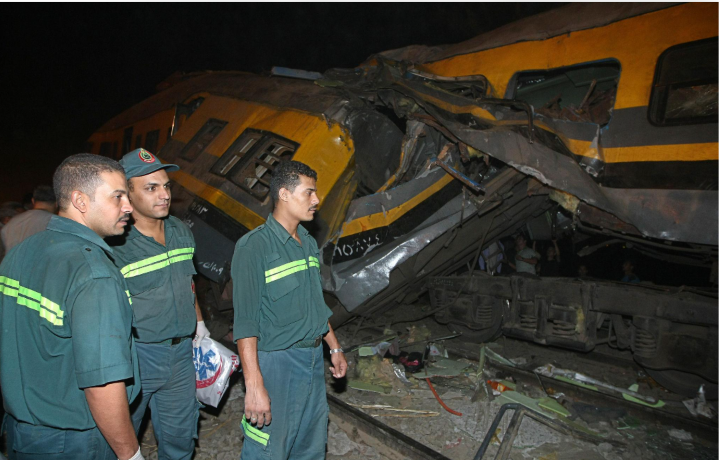
At least seven people have died and 125 others have been injured following a collision involving two passenger trains in Egypt, raising fresh concerns about railway safety and the protection of passengers using the country’s public transportation system.
The accident occurred on Sunday in the al-Ayyat district, approximately 52 kilometres south of Cairo, according to reports from Egyptian authorities.
The collision involved a train travelling from Giza to Fayoum and another passenger train travelling from Cairo towards Aswan.
According to preliminary information, the train travelling from Giza struck the rear of a stationary train operating on the same railway track.
The impact caused serious damage to the affected train coaches, leaving passengers trapped and creating an emergency situation that required the immediate intervention of rescue teams.
Emergency workers, ambulances and other rescue personnel were deployed to the scene to assist victims and transport injured passengers to nearby hospitals.
Local residents also reportedly joined the rescue efforts, helping passengers escape from damaged coaches and alerting emergency services.
Authorities confirmed that seven people had died in the accident, including a train conductor. At least 125 others sustained injuries and required medical attention.
More than 70 injured passengers were later discharged after receiving treatment, according to the report.
The condition of other injured passengers was not fully established in the initial reports.
The Egyptian authorities have begun investigating the circumstances surrounding the collision to determine what caused the accident and whether safety procedures were properly followed.
The country’s chief prosecutor has also launched an investigation following an order from President Abdel-Fattah el-Sissi for a prompt inquiry.
The investigation is expected to examine the events leading to the collision, including the movement of the trains, railway signalling systems and the circumstances that left one train stationary on the track.
Determining the precise cause will be important in establishing whether the incident resulted from technical failure, human error, communication problems or other operational issues.
The accident has renewed attention on the safety challenges facing Egypt’s railway network.
The country operates one of the oldest railway systems in the Middle East and Africa, transporting millions of passengers annually between major cities and communities.
Rail transportation remains important to Egypt because it provides an affordable means of travelling across the country.
However, the railway system has experienced several serious accidents over the years, raising questions about infrastructure maintenance, operational standards and the effectiveness of safety monitoring.
One of the country’s deadliest railway disasters occurred in 2002, when a passenger train caught fire, killing more than 300 people.
Although the government has announced investments in railway modernisation, safety incidents continue to place pressure on the authorities to improve the system.
Modernisation efforts have included investments in railway infrastructure, new trains and improvements to signalling and operational technology.
However, experts and members of the public continue to stress that infrastructure development must be supported by effective maintenance, adequate training and strict enforcement of safety regulations.
The latest collision also highlights the risks associated with railway operations when trains are unable to maintain safe distances or when communication systems fail to provide adequate warnings.
For passengers, railway safety is not only about the condition of trains but also about the reliability of the entire transportation network.
The authorities will therefore face pressure to provide clear information about the cause of the latest incident and explain what measures will be introduced to prevent a similar occurrence.
The investigation could also lead to recommendations concerning railway operations, staff responsibilities and emergency response procedures.
As rescue and investigation activities continue, attention remains focused on the victims and their families.
The incident serves as another reminder of the importance of strong transportation safety systems, particularly in countries where railways remain a major part of everyday public movement.