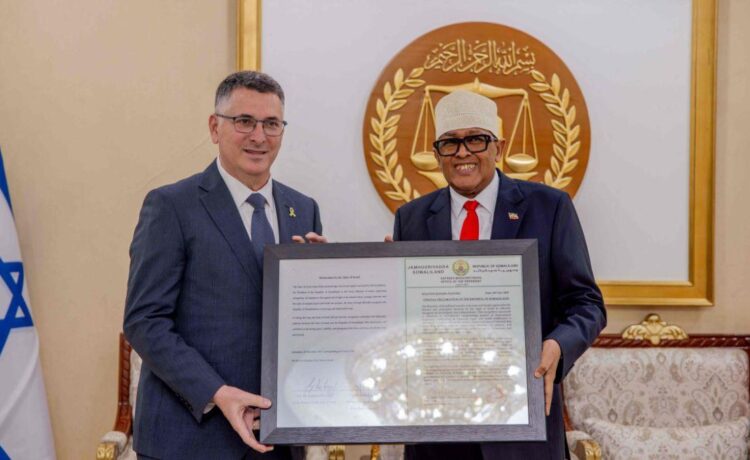
Israel has taken another significant step in strengthening its relationship with Somaliland after its first ambassador to the territory, Michael Lotem, presented his diplomatic credentials to President Abdirahman Mohamed Abdullahi in Hargeisa.
The ceremony, announced by Israel’s Foreign Ministry on November 1, 2026, was followed by the laying of the cornerstone for a planned Israeli embassy in the Somaliland capital.
The development represents a further expansion of diplomatic relations between the two sides following Israel’s decision in December 2025 to recognise Somaliland as an independent state.
President Abdullahi, popularly known as Cirro, described the occasion as historic, noting that it marked the first time a Somaliland president had formally received the credentials of an ambassador from a United Nations member state recognising its independence.
Lotem said Israel’s recognition reflected the development Somaliland had achieved over more than three decades, rather than being simply a diplomatic formality.
Israeli Foreign Minister Gideon Sa’ar also welcomed the appointment, describing the exchange of ambassadors as an important step towards strengthening relations between the two sides.
Al Jazeera+2
Recognition Agreement Dates Back to December 2025
The diplomatic development follows an agreement reached on December 26, 2025, when Israel became the first United Nations member state to recognise Somaliland.
Somaliland declared independence from Somalia in 1991 following the collapse of the Somali central government. Since then, it has operated its own administration, maintained security institutions and conducted elections, although it has not secured wider international recognition.
Somalia continues to regard Somaliland as part of its sovereign territory and strongly rejects attempts to recognise it as an independent country.
Israel’s decision therefore carries significance beyond its bilateral relationship with Somaliland. It has also raised questions about territorial integrity, international recognition and diplomatic relations in the Horn of Africa.
Since the agreement, both sides have taken further steps to establish formal diplomatic representation. Israeli Foreign Minister Sa’ar visited Somaliland in January 2026, while Somaliland subsequently appointed Mohamed Hagi as its ambassador to Israel.
Somaliland also opened an embassy in Jerusalem during President Abdullahi’s visit to Israel in June 2026.
Al Jazeera+2
Somalia Raises Concerns Over Israel’s Strategic Interests
Israel’s growing relationship with Somaliland has attracted strong criticism from Somalia, which argues that the recognition undermines its sovereignty and territorial integrity.
Somali President Hassan Sheikh Mohamud has questioned Israel’s motives, alleging that the country is interested in gaining access to the Red Sea and establishing a naval base in Somaliland.
The strategic importance of the territory is a major factor behind the controversy. Somaliland is located along the Gulf of Aden, close to the Red Sea and the Bab al-Mandeb Strait, one of the world’s most important maritime passages.
The Bab al-Mandeb connects the Red Sea to the Gulf of Aden and the wider Indian Ocean. It is a vital route for international trade, particularly shipping between Europe and Asia through the Suez Canal.
Any expanded military or security presence in the area could therefore attract considerable attention from countries with commercial and strategic interests in the region.
Somaliland officials have indicated that they are open to the possibility of hosting an Israeli military base. However, President Abdullahi has reportedly said that no discussions on establishing such a base have taken place.
The distinction is important because diplomatic recognition and the establishment of an embassy do not automatically mean that a military agreement has been reached.
Al Jazeera+2
Regional Organisations Oppose the Recognition
Somalia’s objections have also received support from regional and international organisations.
The African Union, the Arab League and the Organisation of Islamic Cooperation have condemned Israel’s recognition of Somaliland, expressing concerns about the implications for Somalia’s territorial integrity and regional stability.
The disagreement has added another diplomatic challenge to an already sensitive region, where security concerns, political rivalries and competition over strategic maritime routes remain important issues.
For Somalia, preventing further international recognition of Somaliland remains a key foreign policy objective.
For Somaliland, however, Israel’s decision represents an opportunity to strengthen its international position, attract investment and establish diplomatic relationships with countries willing to engage with its administration.
Israel’s decision has also created a new diplomatic reality that other countries in the region will have to consider, even as most governments continue to recognise Somalia’s territorial integrity.
What the Development Means for the Horn of Africa
The presentation of Lotem’s credentials and the planned Israeli embassy represent more than symbolic diplomatic gestures. They provide a foundation for closer engagement between Israel and Somaliland in areas such as trade, technology, investment and security.
However, the relationship is developing against a background of regional disagreement.
The Horn of Africa occupies an important position in international trade and maritime security. Its proximity to the Red Sea, Gulf of Aden and Bab al-Mandeb makes developments in the area relevant to countries beyond the immediate region.
Any future security arrangement involving Israel and Somaliland could therefore attract further scrutiny from Somalia and other regional governments.
For now, the establishment of diplomatic representation marks a new phase in relations between the two sides. Whether the partnership leads to wider economic cooperation or deeper security arrangements remains to be seen.
The development also leaves a major question for African diplomacy: how should international relations respond when a territory that governs itself for decades remains unrecognised by most of the international community?
As Israel and Somaliland move towards closer cooperation, Somalia’s opposition and the response of regional organisations are likely to remain central to the debate.