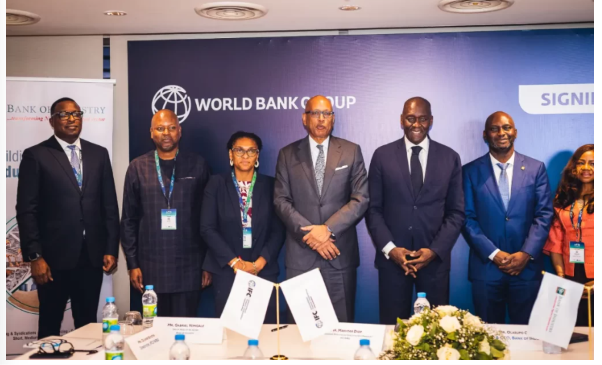
The Bank of Industry Limited (BOI) and the International Finance Corporation (IFC), a member of the World Bank Group, have signed a $50 million senior loan agreement to expand access to long-term financing for micro, small and medium-sized enterprises (MSMEs) across Nigeria.
The agreement is expected to strengthen the capacity of Nigerian businesses to access funding for expansion, production, employment creation and other productive activities.
According to an announcement published by the Bank of Industry on November 3, 2026, the financing forms part of a broader IFC investment package of up to $100 million in support of the development finance institution.
One of the important features of the agreement is its commitment to women-owned businesses.
At least 25 per cent of the loan proceeds will be dedicated to supporting enterprises owned by women, creating additional opportunities for female entrepreneurs seeking long-term financing.
The agreement was signed at the Africa Financial Industry Summit 2026 in Luanda, Angola.
The signatories were the Managing Director and Chief Executive Officer of BOI, Dr Olasupo Olusi, and the Managing Director of IFC, Makhtar Diop.
The seven-year tenor of the loan is expected to strengthen BOI’s funding base and improve its ability to provide longer-term financing to businesses operating in important sectors of the Nigerian economy.
These sectors include manufacturing, agriculture, renewable energy and the creative industries.
Access to financing remains one of the major challenges facing small and medium-sized businesses in Nigeria.
Many entrepreneurs struggle to obtain loans that offer affordable interest rates, suitable repayment periods and financing conditions that match the nature of their businesses.
This challenge can limit business expansion, reduce production capacity and make it difficult for entrepreneurs to invest in equipment, technology and additional workers.
For manufacturing businesses, long-term financing can support the purchase of machinery, expansion of production facilities and improvement of operational processes.
Agricultural businesses may require funding for equipment, storage facilities, processing operations and other investments that improve productivity.
Renewable energy companies also need financing to develop projects and provide alternative power solutions to households and businesses.
The creative industries represent another important area of opportunity because they contribute to employment, cultural development and economic activity.
The BOI-IFC agreement is therefore expected to support businesses across different areas of production and services.
Speaking about the agreement, Olusi described the partnership as a vote of confidence in the Bank of Industry’s mandate and its role in supporting Nigeria’s industrial development.
He explained that the facility would strengthen the institution’s ability to provide long-term financing to MSMEs and productive enterprises, particularly women-owned businesses.
He also highlighted the importance of partnerships that support enterprise growth, job creation and the development of local value chains.
IFC Managing Director Makhtar Diop also emphasised the importance of expanding access to long-term financing for smaller businesses.
He explained that the partnership would combine financing with local capital-market solutions to mobilise additional private-sector investment and expand local-currency funding opportunities.
The focus on local-currency financing is particularly important because businesses that earn revenue in naira can face additional risks when borrowing in foreign currencies.
Exchange-rate fluctuations can increase repayment costs and create financial pressure for businesses with limited foreign-currency earnings.
By supporting domestic financing solutions, the partnership seeks to improve the availability of funding that is more suitable for local businesses.
The agreement also forms part of broader efforts to strengthen Nigeria’s industrial base and encourage private-sector-led economic growth.
However, the signing of the agreement does not mean that every Nigerian business will automatically receive funding.
The financing will be channelled through BOI, and eligible businesses will still need to satisfy the institution’s relevant lending requirements and assessment procedures.
The bank and IFC also indicated that they would continue working towards completing the definitive financing documentation and fulfilling the customary conditions required before implementation.
This means the final implementation arrangements remain an important next step.
For Nigeria, the partnership represents an opportunity to strengthen development finance and improve the availability of capital for businesses that contribute to production and employment.
Small businesses are important to the country’s economy because they support livelihoods, create jobs and provide goods and services across different communities.
Improving their access to suitable financing can help entrepreneurs expand operations, strengthen their competitiveness and contribute to economic development.
Ultimately, the BOI-IFC agreement is expected to support a more inclusive financing environment, particularly for women-owned enterprises and businesses operating in productive sectors.
Its long-term impact will depend on effective implementation and the ability of participating institutions to ensure that the financing reaches businesses capable of using it to generate sustainable economic value.