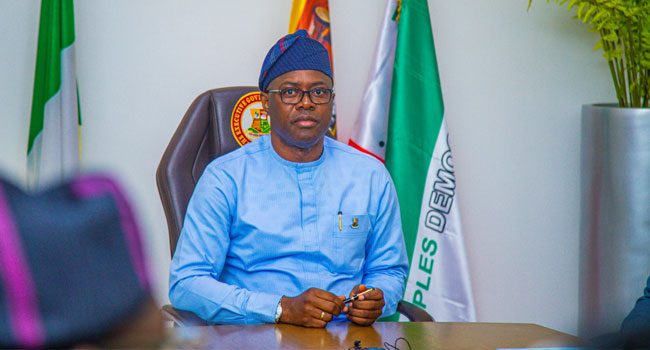
Oyo State Governor and presidential candidate of the Allied Peoples’ Movement (APM), Seyi Makinde, has criticised President Bola Tinubu’s administration over its budgetary processes, arguing that uncertainty surrounding federal budget implementation raises questions about the government’s fiscal management.
Makinde made the remarks on Thursday, October 22, at the APM South-West town hall meeting in Akure, Ondo State, where he presented his political vision ahead of the 2027 general election.
According to reports published by THISDAY and The Guardian, the governor questioned which national budget the Federal Government was implementing, asking whether the country was operating under the 2023, 2024 or 2026 budget.
His comments formed part of a broader criticism of the administration’s economic policies and an appeal for a different approach to governance.
Makinde argued that effective budget planning and implementation were essential to national development, particularly at a time when Nigerians continue to face economic pressures, insecurity and concerns about the cost of living.
The Federal Government’s budget processes and implementation have remained subjects of public debate, with discussions focusing on fiscal discipline, public spending and the delivery of projects promised to citizens.
Makinde said his experience governing Oyo State demonstrated that a more consistent approach to budgeting was possible.
Makinde Highlights Oyo State’s Budget Performance
During the town hall meeting, Makinde compared the Federal Government’s budget implementation with what he described as improvements recorded under his administration in Oyo State.
He claimed that the state’s budget performance had increased from between 28 and 30 per cent before he assumed office to more than 70 per cent under his leadership.
The governor also said his administration had maintained a January-to-December budget cycle for more than seven years.
According to him, annual budgets are usually presented to the Oyo State House of Assembly towards the end of the year and passed before the commencement of the following financial year.
Makinde maintained that consistent planning and implementation could help governments deliver infrastructure and other public services more effectively.
However, the budget-performance figures were claims made by the governor and would require examination against independently verified budget implementation reports to establish the full comparison.
He urged Nigerians to assess his record in Oyo State and consider his proposed policies as an alternative to the current federal administration.
APM Candidate Promises Inclusive Economic Development
Makinde used the gathering to outline his proposed Reset Nigeria agenda, which he said would focus on building an economy that works for citizens across different regions and social groups.
He argued that political leadership should not concentrate public resources and opportunities in particular regions, families or political circles.
The governor criticised what he described as “turn-by-turn nepotism”, insisting that national development should be based on the needs of Nigerians rather than political entitlement.
He said his proposed agenda would prioritise infrastructure, education, security and economic productivity.
Makinde also argued that natural resources alone could not guarantee prosperity without investment in education, skills and human capital.
According to him, improving economic opportunities would help address the concerns of young people and women while ensuring that development reaches communities across the country.
The APM candidate’s message was built around the argument that economic growth should translate into better living conditions for ordinary citizens, regardless of their location or political affiliation.
He also called on eligible Nigerians to obtain their Permanent Voter Cards and participate in the 2027 elections.
Makinde Defends Presidential Ambition
The governor also addressed questions about his decision to contest the presidency despite President Tinubu’s political base in the South-West.
Makinde cited the 1999 presidential election, when former President Olusegun Obasanjo and the late Olu Falae, both from the South-West, contested against each other.
He argued that the historical precedent showed that Nigerians should be allowed to choose among competing candidates based on their policies, experience and capacity to govern.
Makinde also challenged other presidential contenders to demonstrate their physical fitness for the demands of the office, saying energy and the ability to withstand the responsibilities of leadership should be part of the national conversation.
His comments add to the political discussions already emerging ahead of the 2027 general election, as parties and prospective candidates seek to distinguish their policy proposals and leadership records.
APM Leaders Call for Political Change
Other party leaders at the event also criticised aspects of the country’s economic and security situation.
APM National Chairman Yusuf Dantalle described the party as an alternative for Nigerians facing rising living costs and insecurity.
He questioned the impact of compulsory SIM card registration on efforts to tackle kidnapping and banditry, arguing that persistent security challenges required more effective solutions.
Bauchi State Governor Bala Mohammed, who is associated with the APM, expressed support for Makinde’s presidential ambition and urged party members to strengthen their mobilisation efforts.
Meanwhile, Channels Media Group Chairman John Momoh warned political parties against rhetoric that could deepen divisions ahead of the 2027 elections. He emphasised that democratic opposition should not be treated as hostility towards the country.
His comments highlighted the importance of responsible political communication as parties compete for public support.
Economic Management Likely to Remain Key Election Issue
Makinde’s criticism places budget implementation, economic productivity and the distribution of development opportunities among the issues likely to feature prominently in the 2027 election debate.
For voters, the central questions will include whether governments can implement budgets effectively, complete infrastructure projects, improve security and create conditions that support jobs and household incomes.
The governor has presented his Oyo State experience as evidence of an alternative approach, while promising broader reforms if elected president.
The Tinubu administration’s policies and performance will likewise remain subjects of scrutiny as political parties make their cases to Nigerians.
Ultimately, voters will need to assess the competing claims against verifiable records, detailed policy proposals and the practical effects of government decisions on their lives.