The Trump administration’s decision not to publicly oppose a new wave of Western sanctions targeting Israeli settlements in the occupied West Bank is emerging as a significant diplomatic signal to Prime Minister Benjamin Netanyahu’s government as concerns grow over settlement expansion and violence against Palestinians.
Britain, Canada and 10 European countries announced on Tuesday that they intend to introduce or support restrictions on trade involving Israeli settlements, arguing that continued settlement expansion and escalating settler violence are undermining prospects for a two-state solution.
The group comprises Britain, Canada, Denmark, Finland, France, Iceland, Ireland, Norway, Poland, Portugal, Spain and Sweden.
What has attracted particular attention, however, is Washington’s response.
President Donald Trump was briefed about the British initiative before it was announced, according to Axios, but his administration deliberately refrained from condemning it.
Secretary of State Marco Rubio also declined to criticise the sanctions, instead stressing that Washington shared concerns about avoiding further instability in the West Bank.
The response contrasts with the traditionally strong support the Trump administration has extended to Israel and could indicate growing frustration in Washington with developments in the occupied territory.
White House Distances Itself From Huckabee
US Ambassador to Israel Mike Huckabee took a considerably stronger position, publicly condemning the sanctions.
However, a senior White House official told Axios that Huckabee’s comments had not been coordinated with either the White House or State Department.
That distinction is important.
It does not mean Washington has endorsed the sanctions or adopted the same position as Britain and its partners. But the absence of an administration-level condemnation is notable, particularly given the Trump administration’s close relationship with Netanyahu.
Rubio said Washington did not want to see anything that could destabilise the West Bank while declining to directly attack the measures announced by the European and Canadian governments.
The restrained response comes as the United States continues pursuing broader diplomatic objectives in the Middle East that depend partly on cooperation from Arab governments.
Further deterioration in the West Bank could complicate those efforts.
Settlement Expansion Drives Western Action
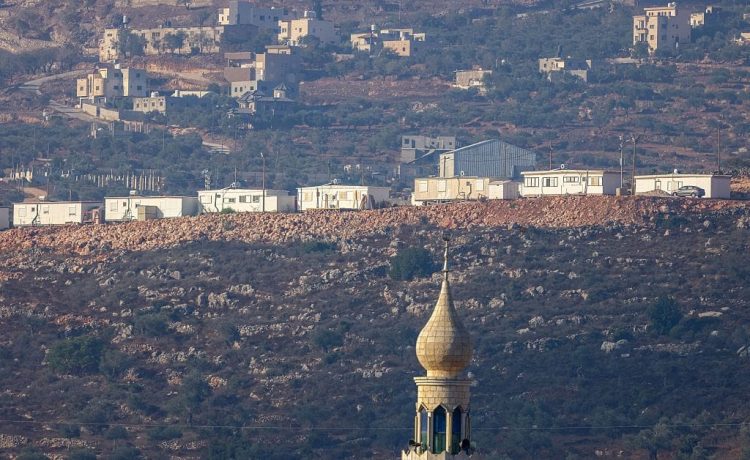
At the centre of the dispute is the rapid expansion of Israeli settlements and rising violence involving settlers and Palestinians.
The 12 governments said they were acting because of what they described as an unprecedented level of settlement expansion and settler violence threatening the possibility of establishing an independent Palestinian state alongside Israel.
Particular concern surrounds Israel’s E1 settlement project, an area east of Jerusalem whose development has long generated international opposition.
Critics argue that large-scale construction there would further disrupt territorial continuity between Palestinian population centres in the northern and southern West Bank, making the geography of a viable future Palestinian state considerably more difficult.
France said Israel’s publication of a tender connected to E1 represented a red line and contributed to its decision to act.
The West Bank has been under Israeli occupation since the 1967 Arab-Israeli war. Israel disputes some international characterisations of the territory and cites historical and security claims, but settlements there are widely regarded internationally as illegal.
The Israeli government rejects that position.
Israel Retaliates Against Britain
Israel has responded particularly strongly against Britain.
Israeli authorities have ordered Britain to close its consulate in East Jerusalem within 30 days. The mission handles British relations with Palestinians in Jerusalem, the West Bank and Gaza.
Israel has also barred 12 British political figures from entering the country, removed British officials from coordination mechanisms and ended British involvement in training Palestinian security personnel in the West Bank.
Israeli Foreign Minister Gideon Saar accused Britain of interfering in Israel’s affairs, while British Foreign Secretary Ed Miliband defended the measures as necessary to preserve the possibility of a two-state settlement.
Britain’s measures include restrictions on settlement goods and services provided to settlements, including activities linked to construction, infrastructure, finance and real estate.
Sanctions May Be More Political Than Economic
The direct economic impact may initially be limited.
Settlement products account for only a relatively small portion of Israel’s overall international trade, meaning the measures are unlikely by themselves to exert decisive pressure on the Israeli economy.
Their political significance could be greater.
Britain, France and Canada have historically been important Western partners of Israel, and their willingness to impose coordinated measures highlights the extent to which the West Bank has become another source of diplomatic isolation for Netanyahu’s government alongside the Gaza conflict.
There is also no guarantee that external pressure will weaken Israel’s political right. With an Israeli election approaching, confrontation with foreign governments could reinforce support among voters who regard international pressure as unjustified interference.
For Washington, the challenge is different.
The United States remains Israel’s most important international ally, but it also needs relationships with Arab governments for wider regional diplomacy.
The Trump administration’s muted response therefore does not amount to a break with Israel. It does, however, send a warning that further settlement expansion and instability in the West Bank could increasingly conflict with Washington’s broader Middle East objectives.