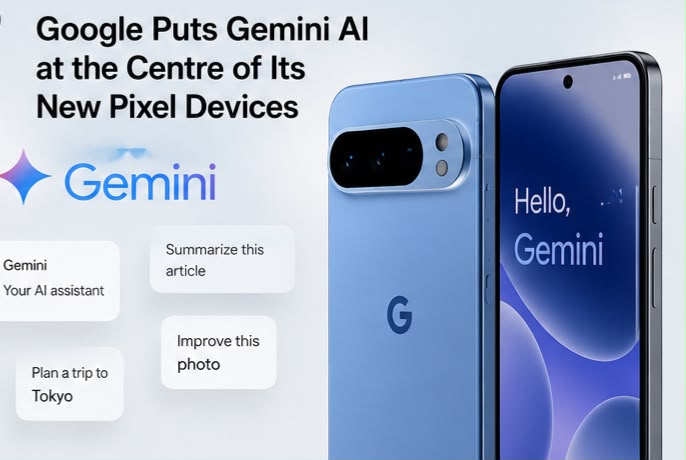
Google is putting artificial intelligence at the centre of its latest generation of consumer devices.
At its Made by Google 2026 event, the technology giant unveiled the Pixel 11 smartphone family alongside the Pixel Watch 5 and Pixel Tag.
However, the hardware was not the only focus.
Google used the event to demonstrate how its Gemini artificial intelligence technology can become deeply integrated into everyday devices.
The move reflects a major shift taking place across the smartphone industry.
Manufacturers are increasingly competing not only on cameras, processors and display technology but also on artificial intelligence.
Gemini Takes Centre Stage
Google’s Gemini AI system is becoming an increasingly important part of the company’s hardware strategy.
Rather than treating AI as a separate application, Google is integrating it into different aspects of the Pixel experience.
The objective is to allow users to interact with their devices in more natural ways.
AI can potentially help users organise information, interact with applications, understand content and complete certain tasks.
This represents a significant change from the traditional smartphone model.
For many years, smartphones were primarily designed around individual applications.
Users opened one app to perform a specific task.
AI assistants could eventually make that process more conversational.
Instead of searching through several applications, a user can describe what they want and allow an AI assistant to help complete the task.
The Pixel 11 Generation
Google’s latest Pixel range includes the Pixel 11, Pixel 11 Pro and Pixel 11 Pro XL.
The company has also introduced a new foldable model.
The new devices combine Google’s hardware with its software and artificial intelligence systems.
Google is also continuing to develop its Pixel Watch range.
The Pixel Watch 5 forms part of the company’s broader strategy to build an ecosystem in which phones, watches and other devices work together.
The Pixel Tag also expands Google’s hardware portfolio into the tracking-device market.
AI Is Becoming a Hardware Feature
One of the most important developments is the increasing integration of AI into hardware.
In the past, artificial intelligence was often presented as an online service.
Users would visit a website or open an application to interact with an AI system.
That model is changing.
Technology companies are now designing hardware specifically around AI capabilities.
This could eventually allow more AI processing to take place directly on devices.
That could improve response times and potentially reduce dependence on cloud servers for certain tasks.
Why This Matters to Consumers
The integration of AI could make smartphones more useful in everyday life.
For example, AI could assist with writing, translation, summarisation, image editing and information management.
It could also help users navigate large amounts of information.
The challenge, however, is ensuring that these features are genuinely useful.
Consumers may not be impressed simply because a smartphone has an AI label.
They will want features that save time and solve real problems.
That means technology companies will increasingly have to demonstrate practical benefits rather than simply promote AI as a buzzword.
Google Faces Growing Competition
Google is not alone in pursuing AI-powered smartphones.
Apple, Samsung and other major technology companies are also investing heavily in artificial intelligence.
The competition is therefore moving toward a new battlefield.
The question is no longer simply which company makes the best smartphone.
Instead, companies are competing over which AI assistant can become the most useful digital companion.
That competition could influence how people use smartphones over the next several years.
The Future of Personal Technology
The Pixel 11 launch also points toward a broader trend.
Artificial intelligence is gradually becoming embedded in consumer electronics.
Phones, watches, computers and other devices are increasingly being designed with AI capabilities from the beginning.
This could eventually change how people interact with technology.
Instead of learning how to use complicated menus and applications, users may increasingly communicate with devices using natural language.
That could make technology more accessible to people who are less comfortable navigating traditional software interfaces.
Privacy Remains Important
However, the growth of AI-powered personal devices also raises questions about privacy.
AI assistants may need access to personal information to provide useful responses.
That creates an important responsibility for technology companies.
Consumers need to understand what information their devices collect, where that information is processed and how it is protected.
As AI becomes more deeply integrated into smartphones, privacy and security will therefore become just as important as performance.
The Smartphone Industry Is Changing
Google’s latest Pixel generation demonstrates that the smartphone industry is entering another stage of development.
The major differentiator may increasingly be intelligence rather than hardware alone.
Cameras will continue to improve.
Processors will become faster.
Displays will become more advanced.
But the companies that successfully combine those features with genuinely useful artificial intelligence could have a major advantage.
Google’s strategy is clear: Gemini is no longer simply an AI assistant that users can choose to open.
It is becoming a central part of the company’s vision for how people interact with their devices.