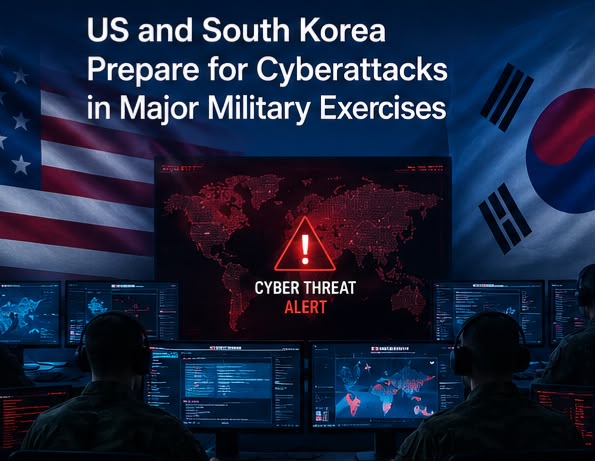
Cybersecurity is taking a more prominent role in military planning as the United States and South Korea begin a major joint exercise designed to prepare for modern security threats.
The annual Ulchi Freedom Shield exercises are scheduled to run from August 17 to August 27.
This year’s exercise includes preparations for threats involving cyberattacks, drones and disruption of GPS systems.
The development highlights how technology has fundamentally changed modern warfare.
Military conflicts are no longer fought only on land, at sea and in the air.
Increasingly, governments must also prepare for attacks against computer networks, communications systems and digital infrastructure.
Cyber Warfare Becomes a Major Concern
Cyberattacks can potentially disrupt military communications and other critical systems without a conventional weapon being fired.
A successful attack could interfere with communications, compromise sensitive information or disrupt infrastructure.
That is why cybersecurity has become an increasingly important component of national defence.
The United States and South Korea are now incorporating cyber-related scenarios into their military preparedness.
The exercises are intended to help both countries improve their ability to respond to a changing threat environment.
Drones Are Changing the Battlefield
Drones are another major focus.
The rapid development of relatively inexpensive unmanned aerial systems has transformed military operations around the world.
Small drones can be used for surveillance, reconnaissance and, in some circumstances, attacks.
Recent conflicts have demonstrated how drones can provide military forces with information and capabilities that were previously much more expensive to obtain.
As a result, military planners are developing new systems for detecting and countering drones.
The US-South Korea exercises are designed to reflect some of these changing battlefield realities.
GPS Disruption Is Another Threat
Modern military operations depend heavily on satellite-based positioning and navigation.
GPS technology supports navigation, communications and the coordination of many military systems.
However, GPS signals can potentially be disrupted or interfered with.
That makes GPS disruption another important scenario for military planners.
The exercises will therefore test responses to a combination of traditional and emerging threats.
This reflects the increasingly complex nature of modern defence.
North Korea’s Changing Capabilities
The exercises are taking place against the backdrop of growing concern over North Korea’s military capabilities.
Officials have pointed to developments involving drones, cyber capabilities and other technologies.
South Korea and the United States have therefore been adapting their military planning to account for these developments.
The objective is not simply to prepare soldiers for a conventional conflict.
Instead, the exercises are designed to test how military and government systems could respond to multiple threats at the same time.
Technology and National Security
The growing emphasis on cyber defence has implications beyond the military.
Modern economies depend heavily on digital systems.
Banks rely on computer networks.
Telecommunications companies operate large digital infrastructures.
Electricity networks increasingly depend on connected technology.
Government agencies also store enormous quantities of sensitive information digitally.
A major cyberattack could therefore affect civilians and businesses as well as military organisations.
For this reason, governments around the world are investing more heavily in cybersecurity.
Businesses are also being encouraged to strengthen their digital defences.
A Changing Definition of Warfare
Technology is changing the definition of national security.
In previous decades, military preparedness focused primarily on weapons, troops and physical infrastructure.
Today, governments must also consider software, artificial intelligence, satellites, networks and data.
The combination of drones, cyberattacks and electronic interference demonstrates how different technologies can work together during a conflict.
For example, an attacker could potentially use cyber operations to disrupt communications while drones are used for surveillance.
That makes defending against individual technologies increasingly difficult.
Military planners must instead prepare for interconnected threats.
The Broader Technology Lesson
The US-South Korea exercises demonstrate why cybersecurity is becoming one of the world’s most important technology sectors.
As more systems become connected, the potential consequences of cyberattacks also increase.
Businesses therefore face growing pressure to protect customer information, financial systems and operational networks.
For technology professionals, this creates demand for cybersecurity specialists, threat-monitoring systems and advanced digital protection tools.
The military exercises also demonstrate that technological innovation can create both opportunities and risks.
Drones, artificial intelligence, satellites and digital networks can make societies more efficient and connected.
However, they can also become targets during conflicts.
The ability to protect those systems will therefore remain an important national-security priority for years to come.