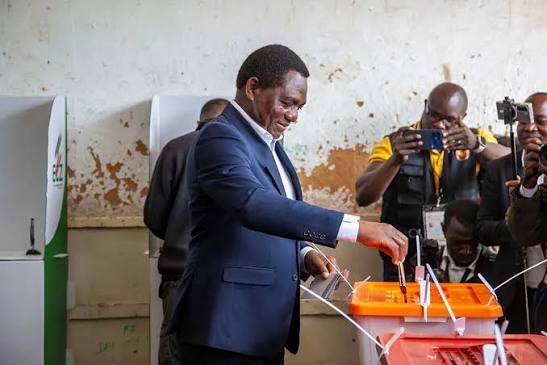
Zambia’s presidential election has entered a tense phase, with President Hakainde Hichilema leading the vote count while authorities face questions over the arrest of several opposition figures.
The election has attracted significant attention across Africa because it is testing both Hichilema’s economic record and Zambia’s democratic credentials.
Zambian police arrested several leading opposition figures on the night of last week’s national election. Authorities said the arrests were connected to alleged threats to national security.
The arrests have intensified political tensions at a time when the country is waiting for final presidential results.
Hichilema Leads the Vote
Preliminary results released by Zambia’s Electoral Commission showed Hichilema ahead of his principal challenger, Brian Mundubile.
With results from 105 of the country’s 226 constituencies reported, Hichilema had secured approximately 54.82% of the votes, while Mundubile had about 43%.
If Hichilema maintains more than 50% of the vote, he would win another term without a runoff.
The result would give Hichilema another five years in office and provide his government with an opportunity to continue its economic programme.
However, the final outcome cannot be declared until the remaining votes are counted and officially certified.
Opposition Figures Arrested
The political atmosphere has become more complicated following the arrest of opposition figures.
Reuters reported that police arrested several opposition figures on the night of the election.
Authorities said the arrests were related to allegations involving threats to state security.
The government has also alleged that police officers came under fire during an operation and that some suspects were connected to military-grade weapons and an alleged plan to cause an insurrection.
Opposition representatives have rejected the government’s characterization of events.
They have demanded information about people they say remain missing.
The competing accounts have added to concerns about whether political tensions could increase as the final results are announced.
A Closely Watched Election
The election was important for Hichilema because his economic record was a central part of the campaign.
When Hichilema came to power, Zambia was dealing with the consequences of a severe debt crisis.
The country had become the first African sovereign borrower to default on its debt during the COVID-19 era.
Hichilema’s government subsequently negotiated debt restructuring agreements with international creditors.
The administration has presented the economic recovery as evidence that its policies are working.
However, ordinary Zambians have continued to face economic pressures.
The cost of living, employment and access to basic services remain important political issues.
Opposition Challenges
Hichilema’s main political opponents have accused his administration of restricting political freedoms.
The government has rejected those allegations.
The authorities argue that law-enforcement actions are directed at genuine security threats rather than political opponents.
The disagreement is now particularly sensitive because Zambia’s election is being closely watched by regional and international observers.
The country has traditionally been viewed as one of Africa’s more competitive multiparty democracies.
Any perception that opposition figures are being unfairly targeted could therefore damage confidence in the political process.
What Happens Next?
The Electoral Commission of Zambia is expected to continue releasing results until the full vote count is completed.
The most important question is whether Hichilema can maintain his current lead above the 50% threshold.
If he does, there would be no need for a second round.
If his support falls below 50%, the election could proceed to a runoff.
The parliamentary and local elections are also being watched closely because they will determine the political environment in which the president governs.
A strong parliamentary majority could make it easier for Hichilema to implement his economic programme.
A stronger opposition presence, on the other hand, could lead to more political bargaining and scrutiny.
Regional Significance
The outcome is important beyond Zambia.
African governments and regional organisations are closely watching elections across the continent, particularly because questions surrounding democratic institutions and peaceful transfers of power remain major issues.
Zambia has generally enjoyed a reputation for peaceful electoral competition.
Maintaining that reputation will depend partly on how political leaders respond to the final results.
The opposition will need to decide whether to accept the outcome or challenge it through legal and constitutional channels.
The government, meanwhile, will face pressure to ensure that security measures do not undermine confidence in the electoral process.
For now, Hichilema remains in the strongest position.
But with final results still pending and opposition arrests creating additional tension, Zambia’s political story is far from over.
The coming days could determine not only who governs Zambia for the next five years, but also how the country’s democracy is perceived at home and across Africa.