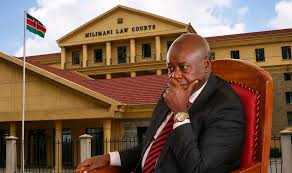
Kenya’s High Court has upheld the impeachment of former Deputy President Rigathi Gachagua, ending a major legal challenge while reinforcing Parliament’s constitutional authority to remove senior state officials from office.
In a landmark ruling, a three-judge bench found that Parliament acted within its constitutional mandate when it impeached Gachagua in October 2024. The judges ruled that impeachment is primarily a legislative function and that courts cannot replace Parliament’s judgment on the reasons for removing a deputy president.
The court, however, found that Gachagua’s constitutional right to a fair hearing was violated during the Senate proceedings.
According to the judges, the Senate should have adjourned the hearings after Gachagua fell ill and was hospitalized. By proceeding in his absence, the Senate denied him a full opportunity to defend himself against the charges brought against him.
As a result, the court awarded Gachagua 50 million Kenyan shillings in compensation for the violation of his rights.
Despite finding a breach of his constitutional rights, the judges ruled that the violation was not serious enough to invalidate the impeachment. The court maintained that the overall process remained constitutional and that the final outcome should stand.
The judges also rejected any possibility of reinstating Gachagua as deputy president. They noted that Kithure Kindiki was lawfully appointed to fill the vacancy created by the impeachment.
According to the court, reversing the decision would trigger a constitutional crisis by creating a situation where Kenya would effectively have two deputy presidents at the same time.
The bench further ruled that once the vacancy had been filled in accordance with constitutional procedures, the courts could not undo the impeachment process.
Gachagua had also challenged the impeachment on grounds that Parliament failed to provide adequate opportunities for public participation.
However, the court dismissed those claims, finding that members of the public had been given sufficient avenues to submit their views before lawmakers considered the impeachment motion.
The judges also rejected allegations that parliamentary speakers failed to remain neutral, ruling that their conduct was procedural and consistent with their constitutional responsibilities.
Gachagua was impeached on 11 charges, including accusations that he made ethnically divisive public statements.
The former deputy president, who was elected alongside President William Ruto in the 2022 General Election, later fell out with the president following the anti-tax protests that rocked Kenya in 2024.
After leaving office, Gachagua launched the Democracy for the Citizens Party (DCP), which has since emerged as a notable opposition movement.
The ruling carries significant political consequences because Kenya’s Constitution bars impeached leaders from contesting future elections.
With Gachagua widely viewed as a potential presidential contender, the judgment presents a major obstacle to his political ambitions.
His legal team has already signaled its intention to appeal the High Court decision, setting the stage for another round in one of Kenya’s most closely watched political battles.