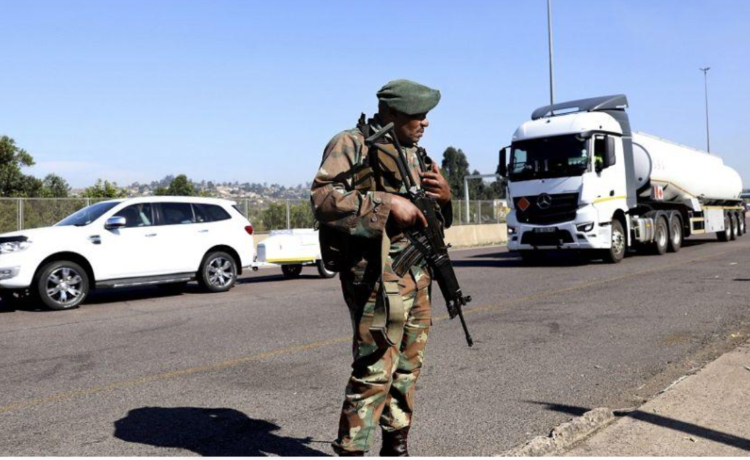
South African President Cyril Ramaphosa has authorised the deployment of 510 members of the South African National Defence Force to KwaZulu-Natal to support police efforts to maintain public order amid anti-migrant protests.
The deployment was reported by Reuters on October 27, 2026, following an announcement from the President’s office.
The soldiers are expected to support police operations as authorities seek to prevent further violence and respond to possible flare-ups associated with protests against undocumented migrants.
The decision comes amid continuing tensions in Durban and other parts of KwaZulu-Natal, where demonstrations linked to immigration and asylum policy have been accompanied by incidents of violence.
The deployment forms part of Operation Prosper, a joint security operation involving law enforcement agencies in several provinces.
According to reporting by South Africa’s Eyewitness News, the deployment is expected to remain in place until November 30, 2026, at an estimated cost of 34 million rand.
The move highlights the government’s concern about maintaining public order while preventing attacks on foreign nationals and damage to businesses and property.
What Led to the Military Deployment?
South Africa has experienced months of heightened tensions surrounding undocumented migration, asylum applications and the enforcement of immigration laws.
Some protest groups argue that the government should take stronger action against undocumented foreign nationals. Their demands have focused on immigration enforcement, employment, crime and access to public services.
However, blaming foreign nationals collectively for social and economic problems can deepen hostility and place migrant communities at risk.
In Durban, protests have at times been accompanied by attacks, property damage and confrontations.
An Associated Press report published several days before the October 27 announcement said a foreign citizen had been beaten to death during a protest march in Durban on October 22. Police had not identified the victim’s nationality in that report, and investigations were continuing.
The reported killing added to concerns about the safety of foreign nationals amid rising anti-migrant tensions.
The government has faced pressure to respond to public concerns about immigration while ensuring that law enforcement remains within the law.
The military deployment is intended to support the police rather than replace the civilian authorities responsible for immigration policy and criminal investigations.
Soldiers to Support Police Operations
Under South Africa’s constitutional framework, the President may authorise the employment of the defence force in cooperation with the police, subject to applicable legal requirements.
The deployment notice submitted to Parliament provides for 510 soldiers to support security operations in KwaZulu-Natal.
Eyewitness News reported that the operation is expected to cost approximately 34 million rand and continue until November 30.
The troops are intended to support police in maintaining law and order and remaining on standby for possible further disturbances.
The announcement does not mean that the military has been assigned responsibility for deciding immigration status or determining who may remain in South Africa. Those matters remain governed by the country’s laws and relevant state institutions.
The effectiveness of the deployment will depend on coordination between the military, police and other agencies, as well as the ability of authorities to respond lawfully and proportionately to incidents.
The presence of soldiers may provide additional support during periods of heightened tension, but long-term stability will also require investigation of criminal offences, protection of vulnerable residents and efforts to address the underlying causes of unrest.
Misinformation Adds to Tensions
South African authorities have pointed to misinformation surrounding a court judgment on asylum applications as one factor contributing to the unrest.
The dispute illustrates how misunderstandings about immigration law can spread rapidly and increase tensions between communities.
A court ruling concerning the processing of asylum applications does not automatically grant citizenship or permanent residence to every undocumented migrant. The legal position depends on the specific judgment, the relevant legislation and the circumstances of each case.
Officials have stressed that immigration and asylum matters must be handled through lawful procedures rather than intimidation or violence.
Misinformation can make it more difficult for authorities to explain policy changes and can encourage people to take action based on inaccurate claims.
The government and civil society groups therefore face the challenge of providing clear public information while protecting freedom of expression and the right to peaceful protest.
Public communication is particularly important when legal decisions are complicated or when changes to immigration procedures affect large numbers of people.
Protecting Foreign Nationals and Local Communities
The latest deployment has renewed attention to the protection of foreign nationals living and working in South Africa.
Migrants from other African countries contribute to economic activity through employment, business ownership and participation in local communities. At the same time, South Africa continues to face significant social and economic challenges, including unemployment and inequality.
Those problems require policy responses that address their underlying causes rather than collective blame against particular nationalities.
Authorities have a responsibility to investigate violence, protect people from attacks and ensure that individuals accused of crimes are dealt with through lawful processes.
Foreign nationals who experience threats or violence should be able to report incidents to the appropriate authorities without intimidation.
Local residents also have the right to raise concerns about public services, crime and immigration policy through peaceful and lawful channels.
Protecting these rights is important for preventing disputes from escalating into broader communal violence.
Economic and Regional Implications
Persistent unrest can affect businesses, transport services, tourism and investor confidence.
When demonstrations turn violent, shops may close, deliveries can be interrupted and residents may avoid affected areas. Businesses owned by both South Africans and foreign nationals can suffer losses.
Violence against migrants can also strain diplomatic relations with countries whose citizens live and work in South Africa.
The protection of foreign nationals is therefore not only a domestic security concern but also an issue affecting South Africa’s relationships with other African countries.
The government faces the challenge of enforcing immigration laws while maintaining public order and meeting its legal obligations to protect people from violence.
A security deployment can provide temporary support, but sustained progress will require effective policing, functioning immigration systems, reliable public information and accountability for criminal conduct.
What Happens Next?
The deployment is scheduled to continue until November 30, 2026, according to the notice reported by Eyewitness News.
During this period, authorities will need to monitor the security situation, investigate reported attacks and ensure that military support remains within the scope of its authorised duties.
The presence of soldiers alone cannot resolve all the political, economic and social issues contributing to anti-migrant sentiment.
Government agencies, community leaders and civil society organisations may also need to strengthen public communication, discourage xenophobic rhetoric and promote peaceful ways of addressing local concerns.
Investigations into violence should proceed independently, with suspects treated according to the law and victims given appropriate protection.
South Africa’s deployment of 510 soldiers to KwaZulu-Natal reflects the government’s concern about continuing anti-migrant unrest and the risk of further violence.
The operation is intended to support police efforts to maintain public order while authorities respond to protests and security incidents.
However, the longer-term challenge extends beyond the deployment itself. Protecting foreign nationals, enforcing immigration laws fairly, countering misinformation and addressing criminal conduct will remain essential to restoring public confidence.
As the situation develops, the government’s response will be judged not only by its ability to maintain order but also by its commitment to the rule of law and the safety of all people living in South Africa.